

Château de Malmaison
Joséphine and Napoleon’s splendid love nest not only kicked off the profession of interior design, it remains a well-spring of design inspiration today.

Where to start? There are so many angles to the Malmaison story that I sat paralyzed before my computer for an entire day pondering how to tackle it in this post. Do I go personal and launch with Napoleon and Joséphine’s passionate love affair that often played out within the walls of Malmaison? Then again, what about Joséphine’s affair with the house itself? She paid a fortune for the derelict estate and transformed it into something magnificent. And sometime later, the empress managed to “get the house” in her divorce from the emperor, this at a time when women typically did not own property in their own names.
Another focus that’s fascinating is Josephine and Napoleon’s dream team of designers, Charles Percier and Pierre-François-Lèonard Fontaine, whose relationship with each other was both professional and personal. There is no definitive proof that they were romantic partners, but they once lived together and remained close in death, buried as they are buried side-by-side at Fontaine’s request, in a tomb designed by him for the express purpose of being laid to rest near Percier who had predeceased him.
The two men are often considered the first professional interior designers in the modern sense of the word. At Malmaison, the duo were the masterminds for every element of the Bonapartes’ renovation from the architecture all the way down to the tiniest furnishings, much like a design firm would do today. Prior to Malmaison, renovation and interior design projects were handled by a wide array of professionals who may well have cooperated with each other but were not guided by the uniform direction of one firm.
Another angle might be this: Joséphine’s garden, perhaps the impetus behind the acquisition of Malmaison in the first place. After she bought the estate, she said she intended to create “the most beautiful and curious garden in Europe, a model of good cultivation.” Joséphine went on to introduce over 200 new plants to France and her rose garden at Malmaison, with over 250 varieties, was legendary. Her roses (and lilies) were memorialized by Belgian artist Pierre-Joseph Redouté. The prints Redouté made for Joséphine remain popular today. About all I did decide during my first pass at this post, was that I would tackle Josephine’s fabled garden with its massive greenhouse and exotic follies, flora and fauna in a later post. Part of her greenhouse complex still survives and I had lunch and a history lesson from its current owner. Stay tuned.
With that meandering introduction, let’s turn to the storied home. As far as châteaux go, Malmaison is a small and relatively simple one, but it’s a jewel.
Built in the early 17th century, Josésphine purchased Malmaison in 1799 for the then princely sum of 325,000 francs. She used borrowed money while Napoleon was away in Egypt. Not only was it a fixer upper that would require an extensive costly renovation, but Napoleon had already passed on the property the previous year when the couple saw it together due to its high price and poor condition. And so….while the cat was away, the mouse bought a house. It must have been love…of the house, not so much in that particular moment, her spouse.
Located about 7 miles outside Paris, Joséphine wanted a ‘place in the country’ for her and Napoleon to escape the intensity of Paris. Initially Napoleon was furious about the purchase, but eventually Joséphine won him over. Together, the pair hired Percier and Fontaine to handle the renovation, and ultimately the Bonapartes were so happy there that Joséphine’s daughter Hortense described Malmaison as “a delicious spot.”
Joséphine lived at Malmaison until her death in 1814. Although she agreed in her divorce settlement that she would not visit Paris or participate in court life, Napoleon continued to visit her at the estate and the couple regularly corresponded. Prior to his exile in Elba, she wrote Napoleon that, for him, she would leave her cherished Malmaison to join him in Elba. This loving offer happened when she learned that his second wife would not accompany him to the remote island. After Joséphine died, Napoleon journeyed to Malmaison to pay homage to Joséphine before departing for his second exile, this time to the isle of St. Helena. Later, a friend sent him seedlings from Malmaison to plant on the island. Dubbed the “Everlasting Daisy,” the yellow flower now blossoms all over St. Helena despite earlier attempts by a disgruntled British governor to eradicate it. Despite their marital difficulties, Josephine and Napoleon had an enduring, passionate relationship and much of it was staged at Malmaison. “Joséphine” was the last word Napoleon spoke and Joséphine uttered his name in her final moments too.
Back when Percier and Fontaine were commissioned to overhaul Malmaison, they devised a scheme commensurate with Napoleon and Joséphine’s rising status. The decoration at Malmaison, which later became known as the Empire style, is rife with symbols of imperialism, almost like a secret code. Like Louis XIV’s home at Versailles before him, Napoleon (who reputedly detested Versailles) used interior design as a political tool—a surrogate for power—that would impress others. Napoleon had admired the grandeur of the Ancient Roman empire, so Percier and Fontaine’s rooms at Malmaison reference the classicism of this era with columns, caryatids and laurel wreaths. The qualities of courage, strength and wisdom emanate from the architecture and furniture they designed with motifs of lions, eagles and armor. Industrious Napoleon was given the symbol of a bee and his wife, Joséphine, that of a beautiful swan, much like the ones she brought to the estate. Throughout the home, bees and swans are seen in the fabrics, furnishings and on other adornments.
Since Napoleon was off on campaigns more than he was ever in France, Joséphine strove to create an environment where he would feel at ease when at home. This led to the creation of military motifs found in the decoration of many rooms at Malmaison. (Why Napoleon was apparently comforted by references to battle is beyond the scope of this post. I have enough angles! Ha! )
To accommodate Napoleon’s busy schedule, Percier and Fontaine were regularly charged with completing projects in short spurts so that workers would not be present when the couple was in residence. To created the desired environment within Napoleon and Josephine’s time constraints, the design duo came up with the idea of draping fabric over the walls. It was quick to install and it mimicked the interior of a military tent.
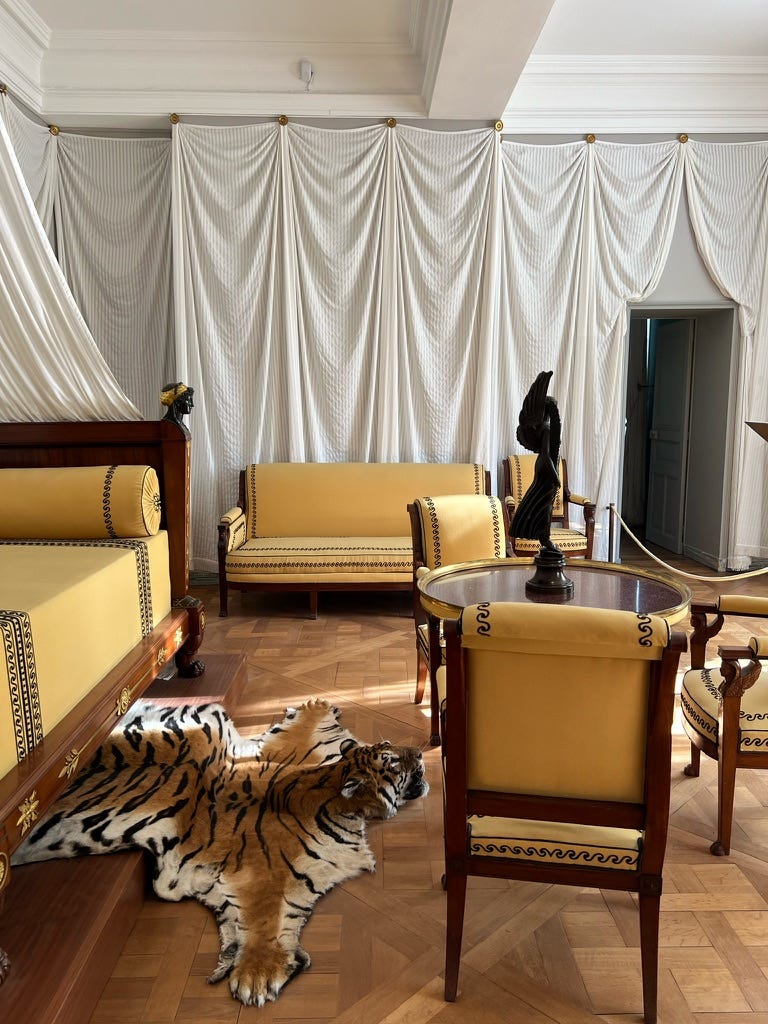
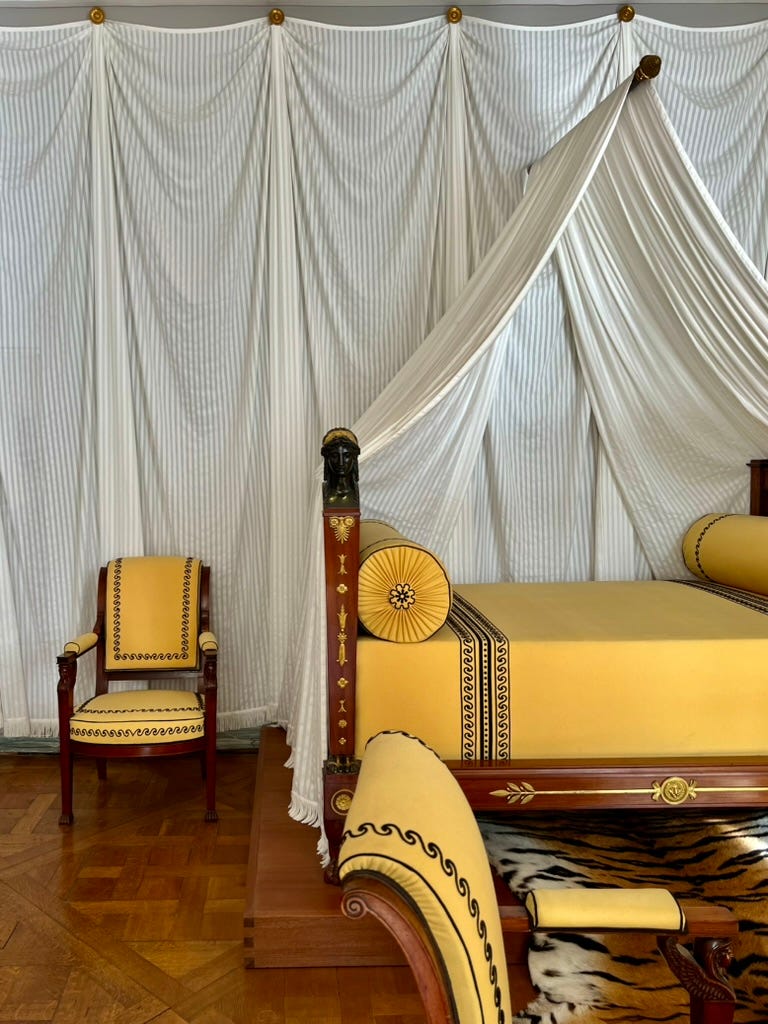
Draped walls became a signature feature of Malmaison and Napoleon’s bedroom is a prime example. Here, Percier and Fontaine encased the room with a simple white-on-white striped fabric that conformed to Napoleon’s taste and budget and laid the floor with a tiger skin rug to evoke his quarters in an army camp. They used a “lit de repos,” for the bed. Like a day bed, it lacks a headboard (apparently sleep luxury was not a thing during the Napoleonic wars of the 19th century) , and the “lit” is positioned on a platform so that the general would have a view of his “battlefield”.
The decoration of Joséphine’s bedroom features draped fabric as well, but this came later after her marriage to Napoleon ended. Although she kept most of Percier and Fontaine’s designs at Malmaison in place, she wanted to completely refresh her bedroom. Seems understandable. Actually, it sounds heart wrenching. In 1809, Napoleon told Joséphine they would be divorced, yet the couple made statements of devotion to each other at the official ceremony. Apparently, the divorce took place when Napoleon could no longer ignore that his 46 year old wife was too old to produce an heir.
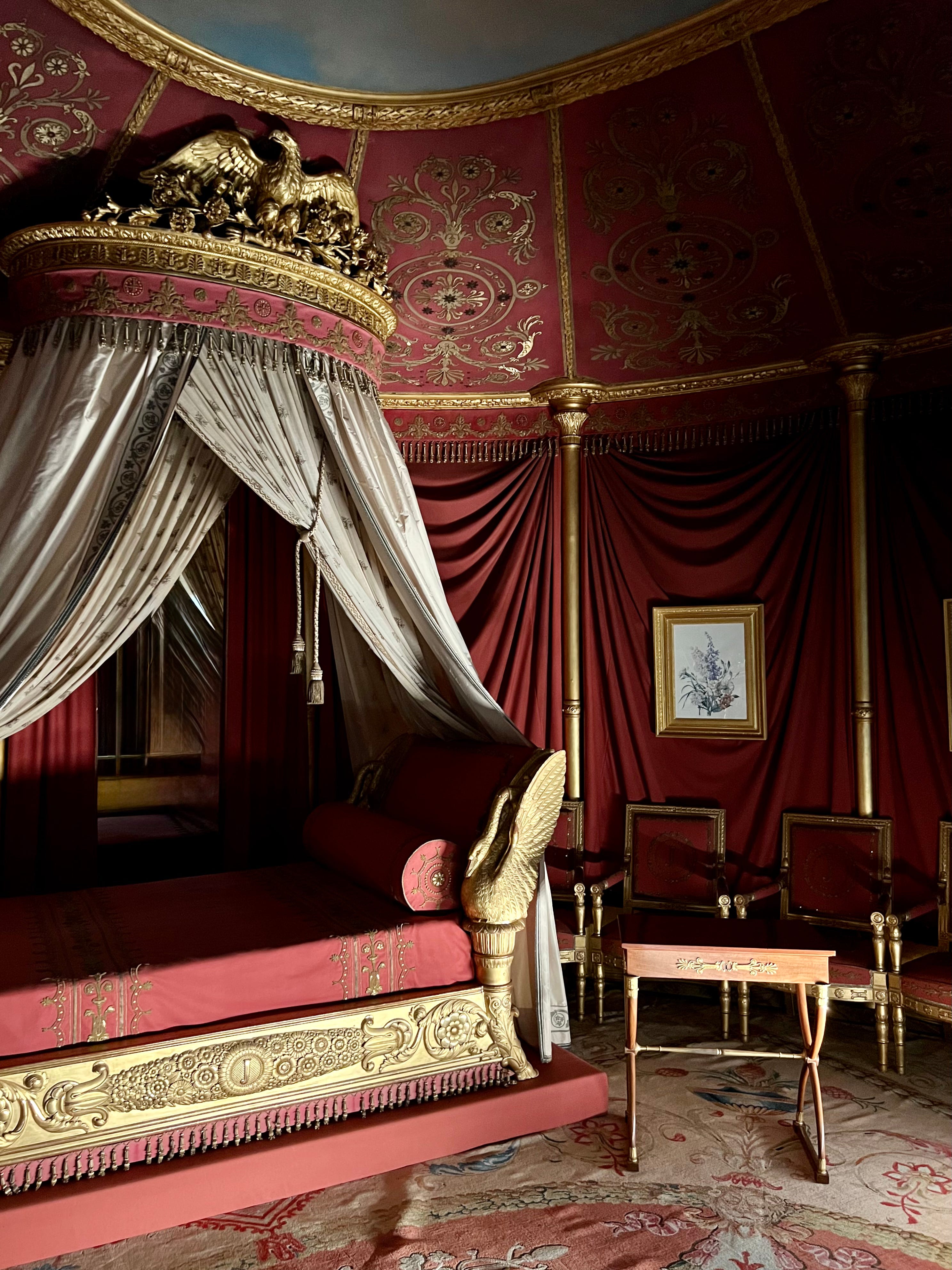
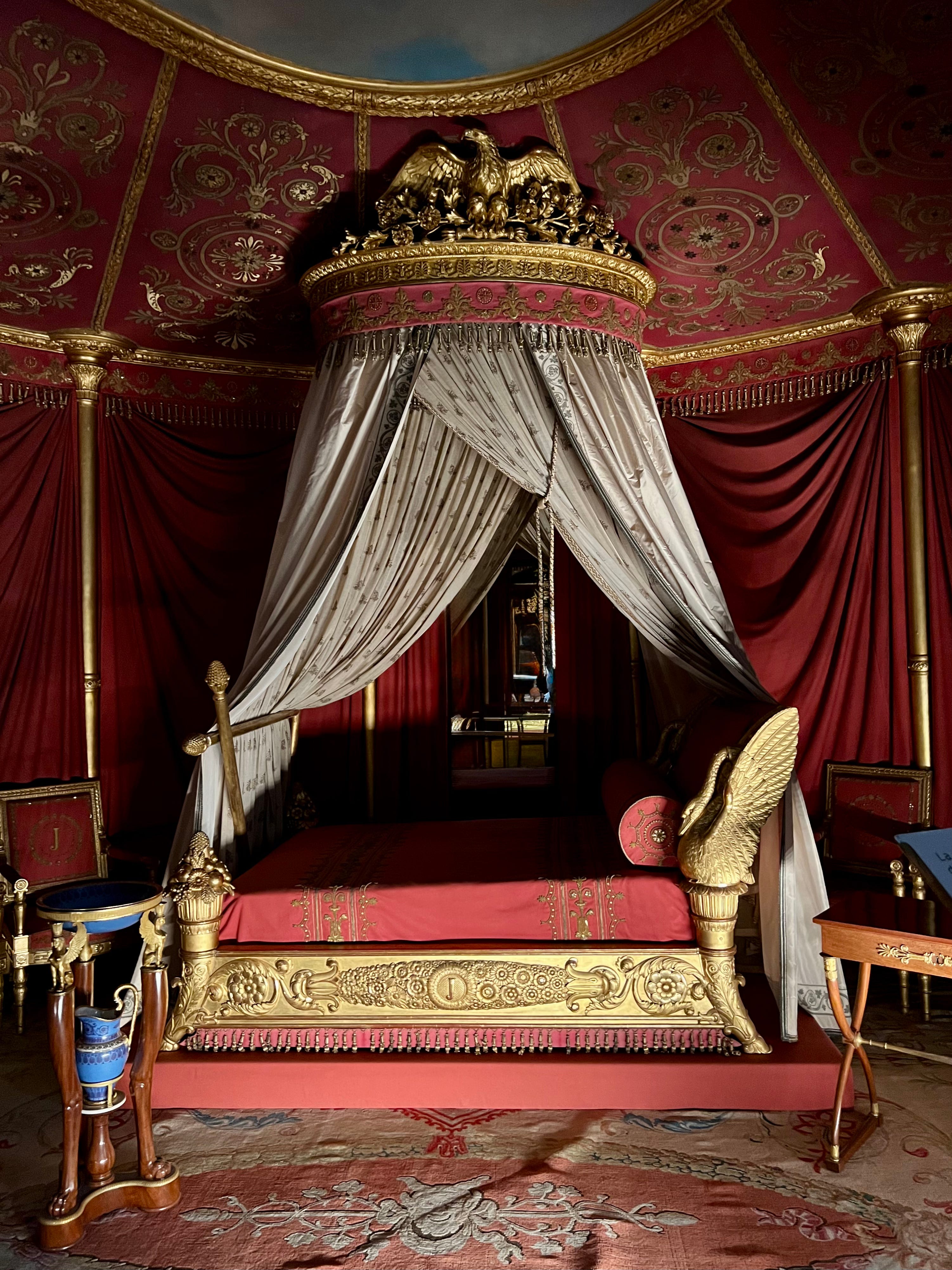
Josephine hired Louis-Martin Berthault as she tinkered with redecoration at Malmaison. To assuage her grief (one can imagine) she had Berthault create one of the most lavish spaces in the château for her bedroom. Berthault swathed the room in rich red fabric embroidered in gold and hung mirrors and Redouté prints of Joséphine’s roses on the walls to fashion a circular, tent-like chamber. The artist Blondel painted a cloud-filled sky on the ceiling featuring Juno charging on his chariot. In this way, Joséphine showed the world that her imperial status remained undiminished and that she continued to live a life filled with beauty, divorce be damned!
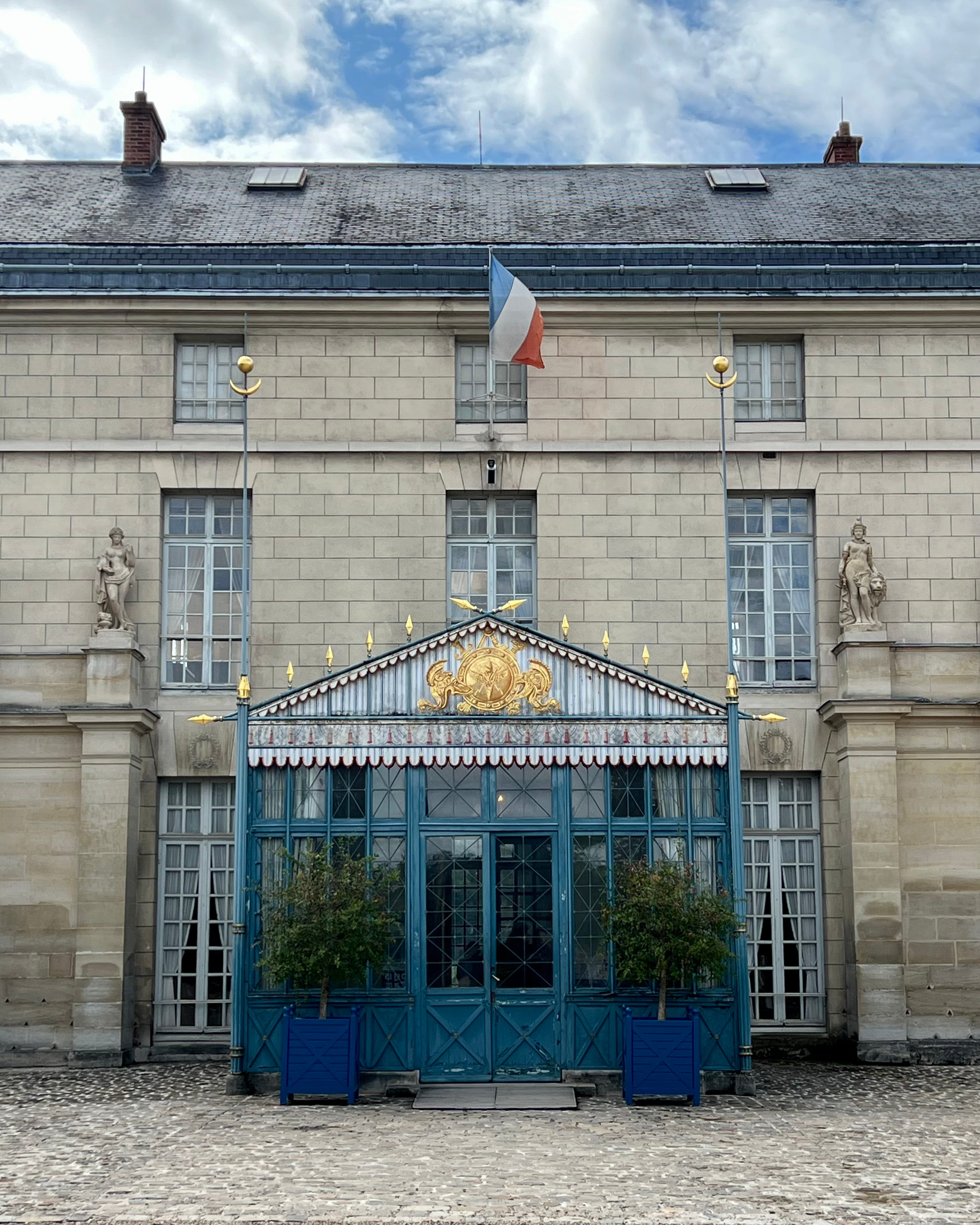
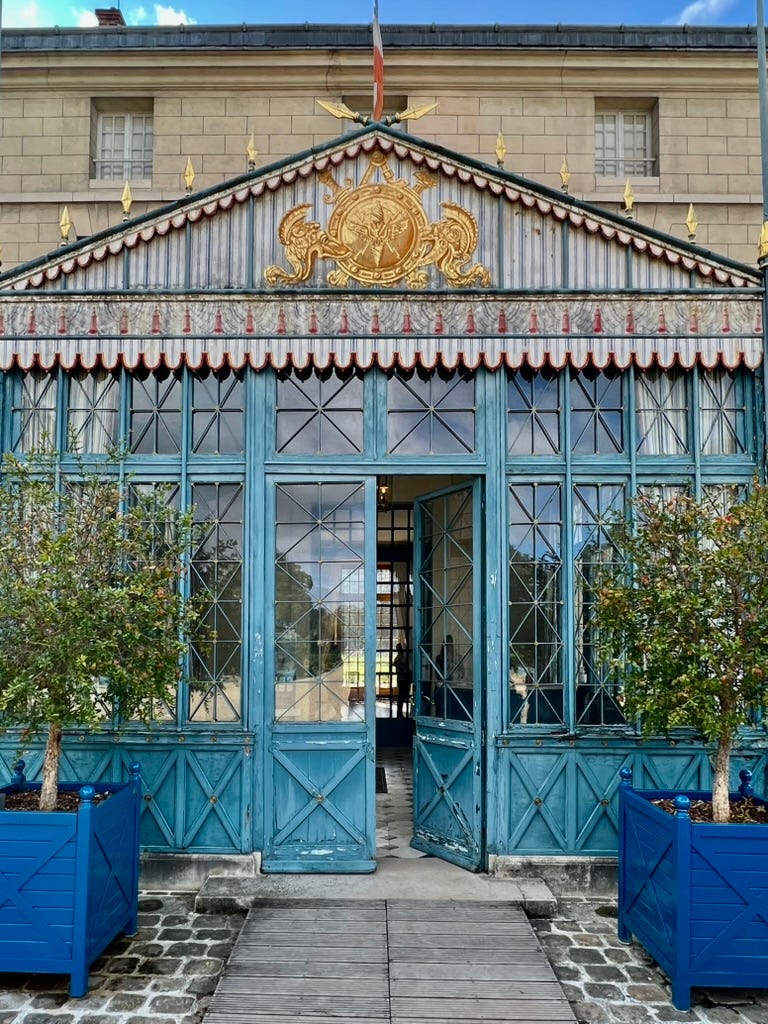
Malmaison’s entrance pavilion and Napoleon’s office (which Percier and Fontaine are said to have executed in eight days) also recall military tents. Here, the designers chose blue and white stripes accented in red and featured accoutrements of war such as pikes and shields.
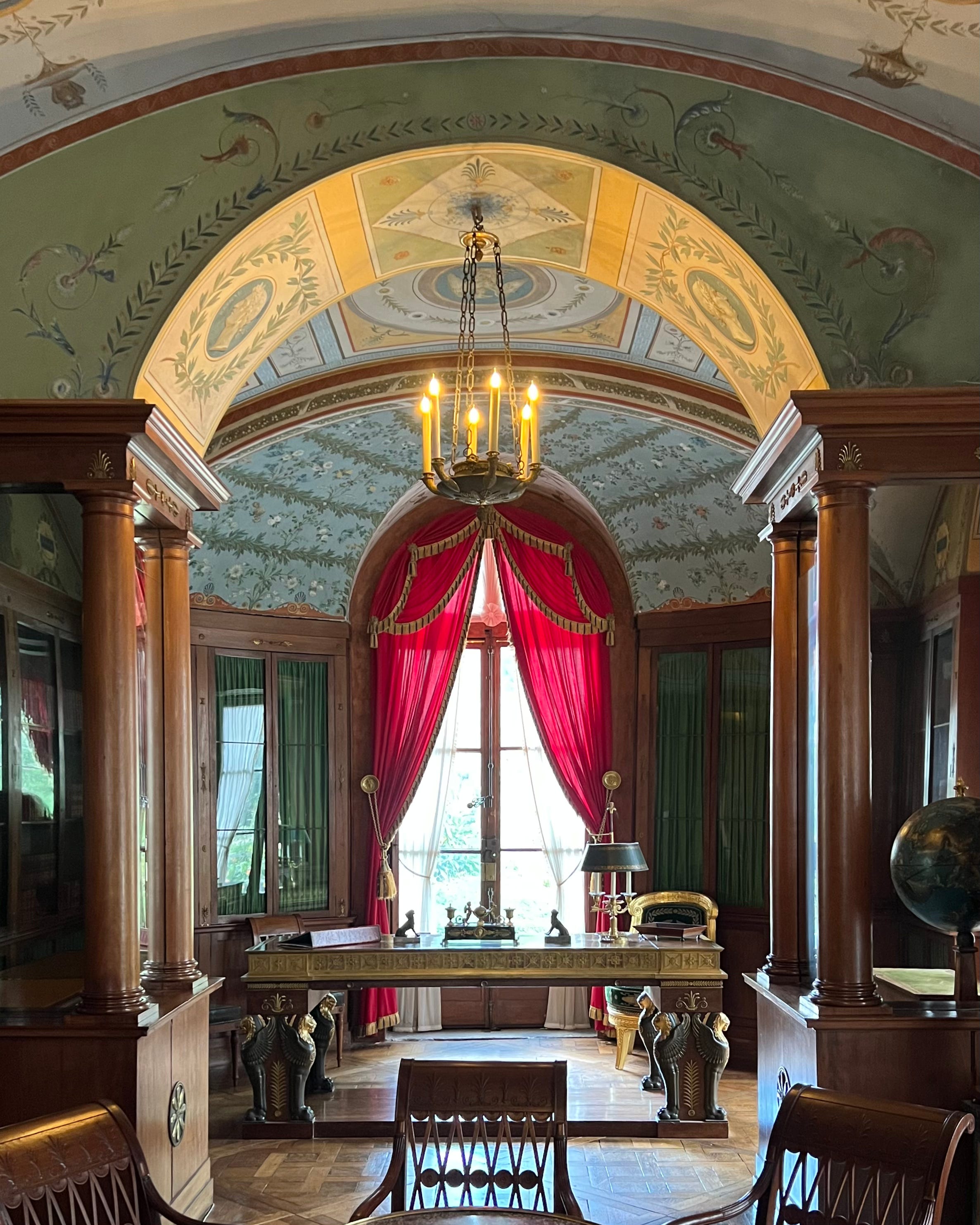
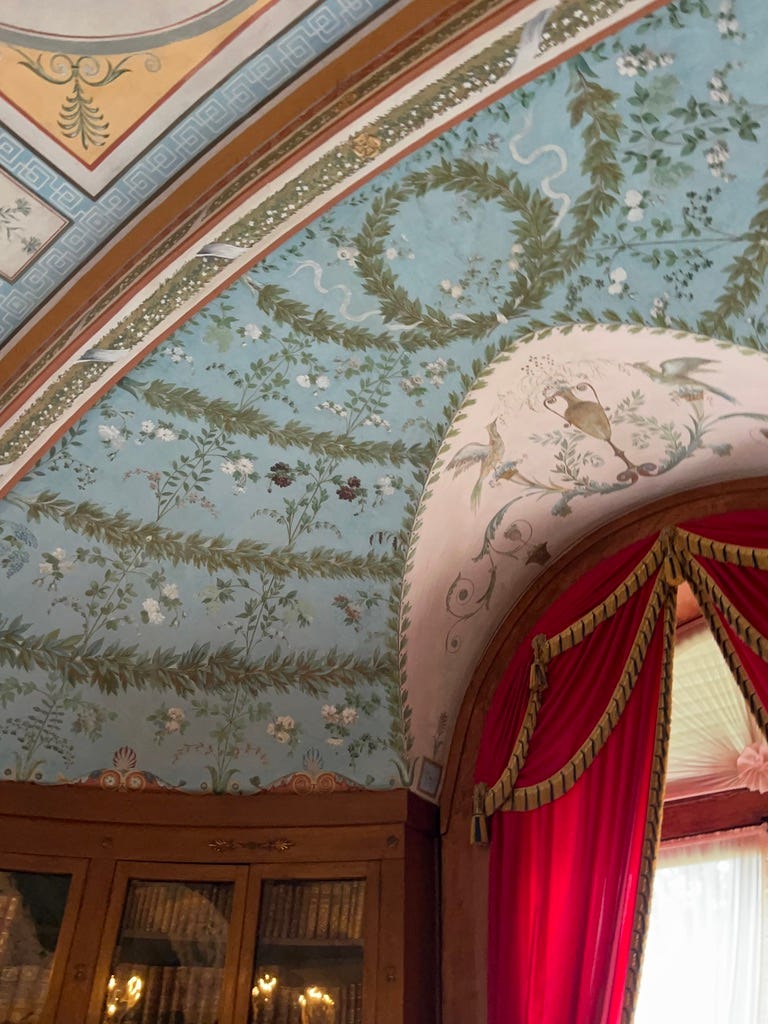
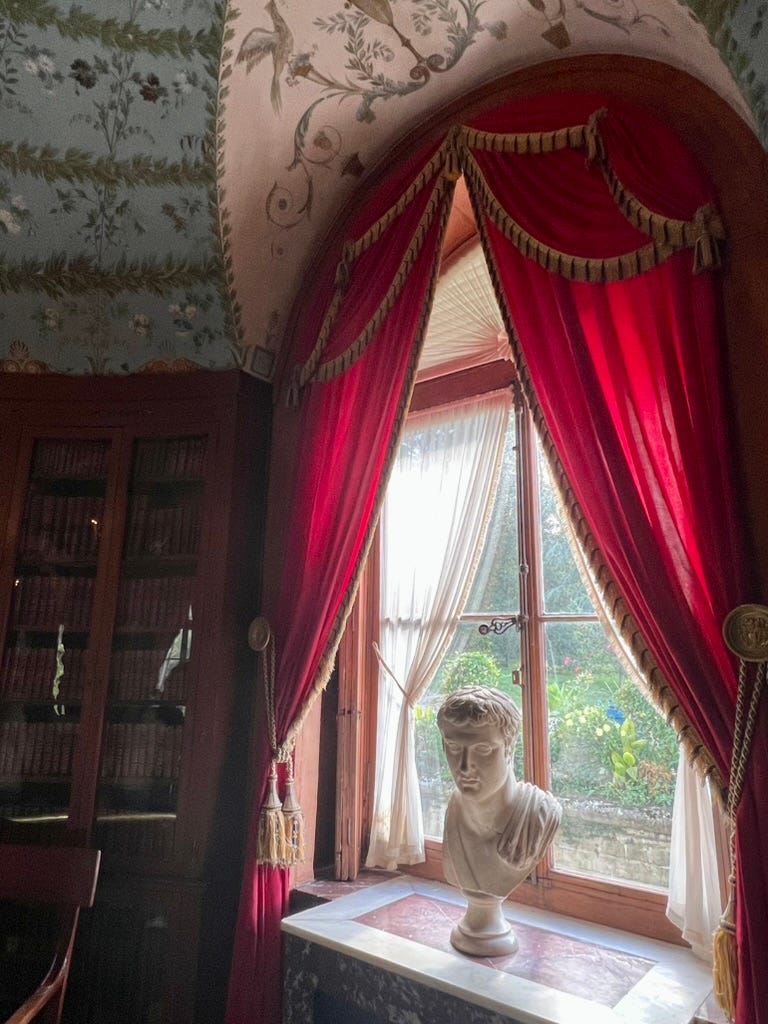
Other rooms at Malmaison depart from martial-inspired decoration and instead reflect Percier and Fontaine’s architectural study in Italy. The front vestibule was designed to evoke the feeling of a Roman villa’s atrium. Receding mirrored panels open the space to adjoining rooms to create large reception areas. The dining room has murals that recall the excavations at Pompeii. Napoleon’s library is treated to bookcases with Palladian-style columns and the ceiling is painted to allude to his favorite classical authors and with foliage reminiscent of Joséphine’s beloved flowers.
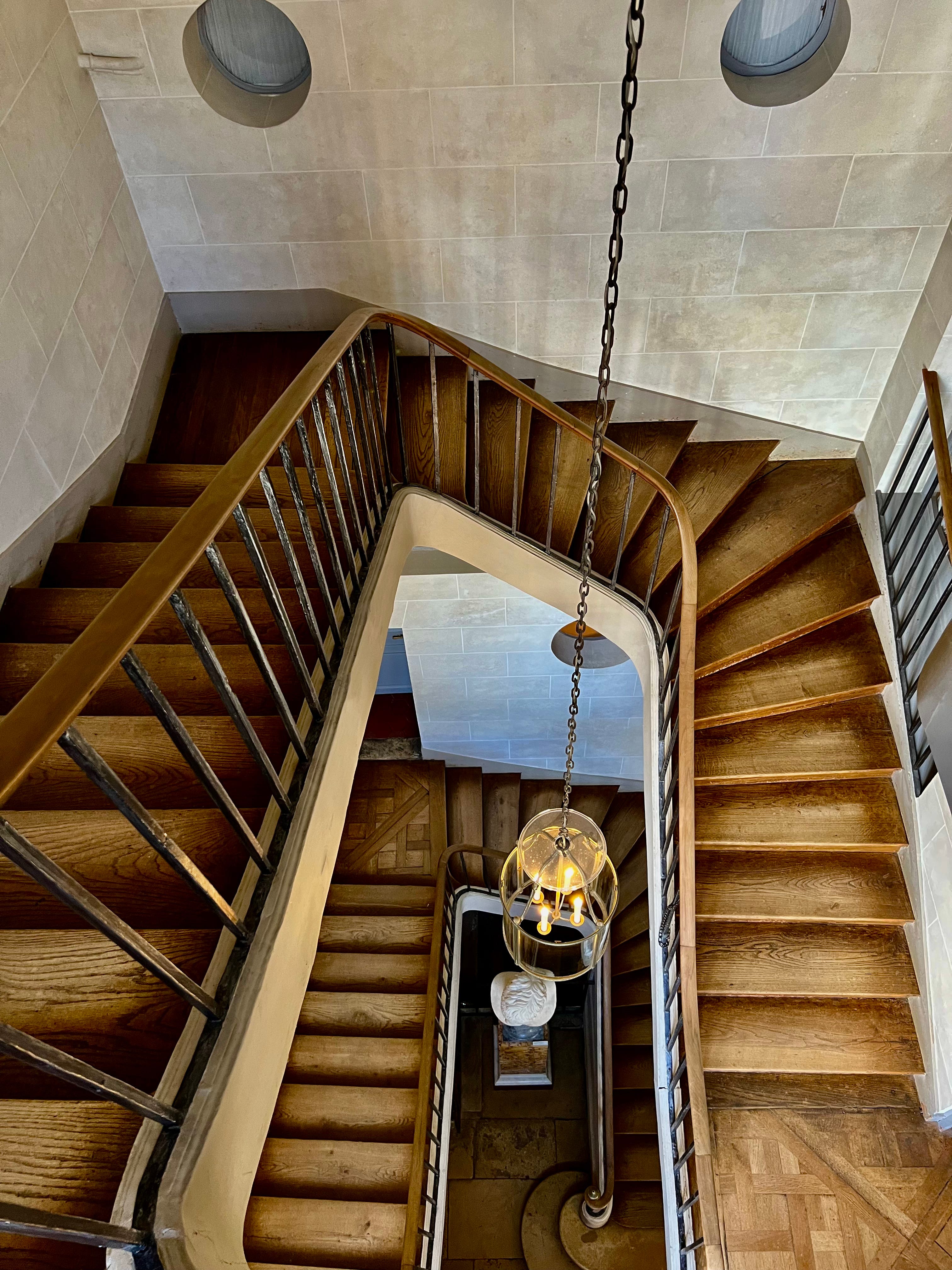
At Malmaison, the desire to foster a sense of familiarity and ease for Napoleon together with the couple’s prominence has led to an interesting juxtaposition of graceful simplicity and splendor evident in the architecture as well as in the smallest decorative details. For example, rich black and white checkered marble floors set in a porphyry marble grid span the entire first floor, yet co-exist with a plain staircase and balustrade made completely in wood. Likewise while the seating throughout the chateau is upholstered in rich, smartly embroidered cashmere, the window curtains are often done in simple muslin. The lighting and furniture in the house also suggest the contrast. They are either highly elaborate or stylishly sleek. For instance, some chandeliers drip with crystals while others are rendered in a spare tole, a painted or lacquered tin. Similarly the house features large-scale, heavily gilded furniture alongside linear “campaign furniture,” so called as it is based on that used by military officers since it could be easily folded and packed for travel while on a battle campaign.
So much of Malmaison continues to captivate home enthusiasts. The restrained elegance of the chateau is often emulated, think the current vogue for “quiet luxury.” Every time you see a tented space or one draped in fabric, it has roots at Malmaison. As for furnishings, antique and reproductions of the campaign style furniture-as well as the lighting—seen at Malmaison are highly sought after in today’s marketplace. Even the upholstery elements at the château are regularly copied. In short, the place is somewhat of a mecca for design nerds. Malmaison is open to the public and easily accessible from Paris. I went by bus with the Decorative Arts Trust, but I urge a lengthy independent visit so you can linger over the finer points. Uber is reported to be the easiest way to get there.
Bon voyage,
Lynn
Photography
All photographs of the Château de Malmaison are by Lynn Byrne.
Napoleon’s Bedroom
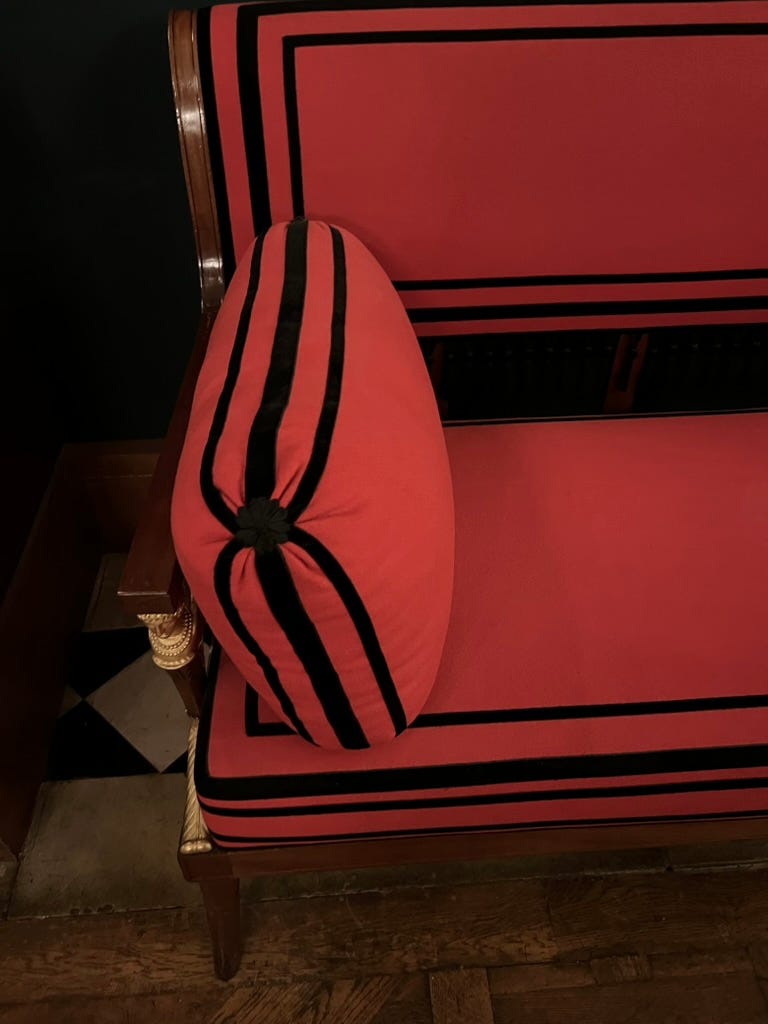
Napoleon’s bedroom is designed to recall the interior of a military camp tent, featuring a tonal white striped fabric draping the walls and furniture upholstered in embroidered, yellow cashmere. The ends of the bolster pillows are notable for their pleating and flower-shaped, button trim.
Joséphine’s Bedroom
Joséphine’s bedroom also is swathed, tent-like, in fabric, a feature characteristic of Malmaison, first photo and below. Note the swan, Josephine’s symbol, on the wooden bed designed by Desmalter in 1812.
Entrance Pavilion
The Entrance Pavilion at Malmaison resembles a battlefield tent.
A closer look shows the trompe l’oeil tassles and draping on the frieze of the pavilion.
Consul’s Office
Napoleon’s Consuls Office was reputedly executed by Percier and Fontaine’s team in 8 days. It houses a copy of a famous portrait of Joséphine by François Gérard .
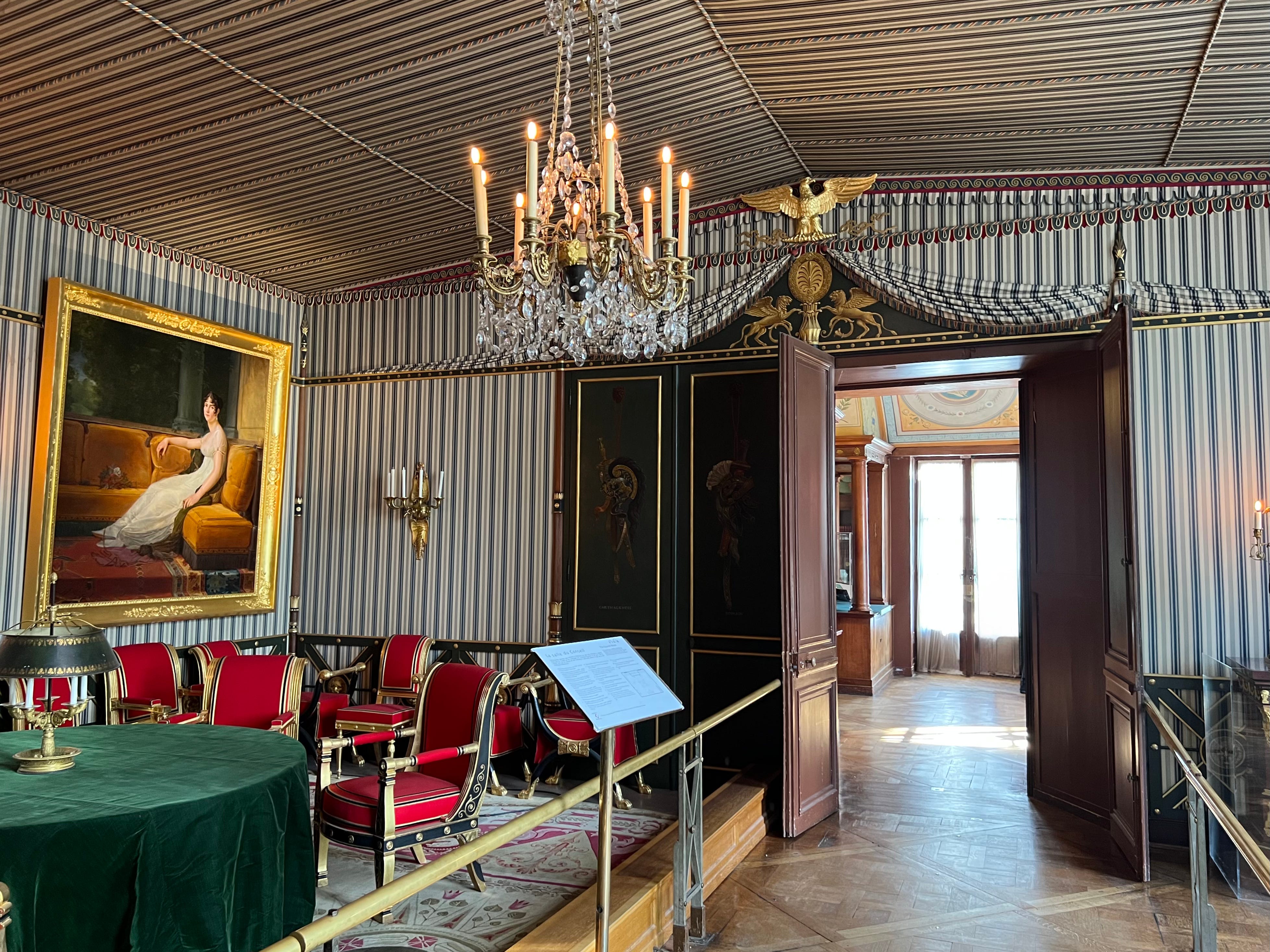
The seams of the striped fabric panels are hidden by a pretty braid.
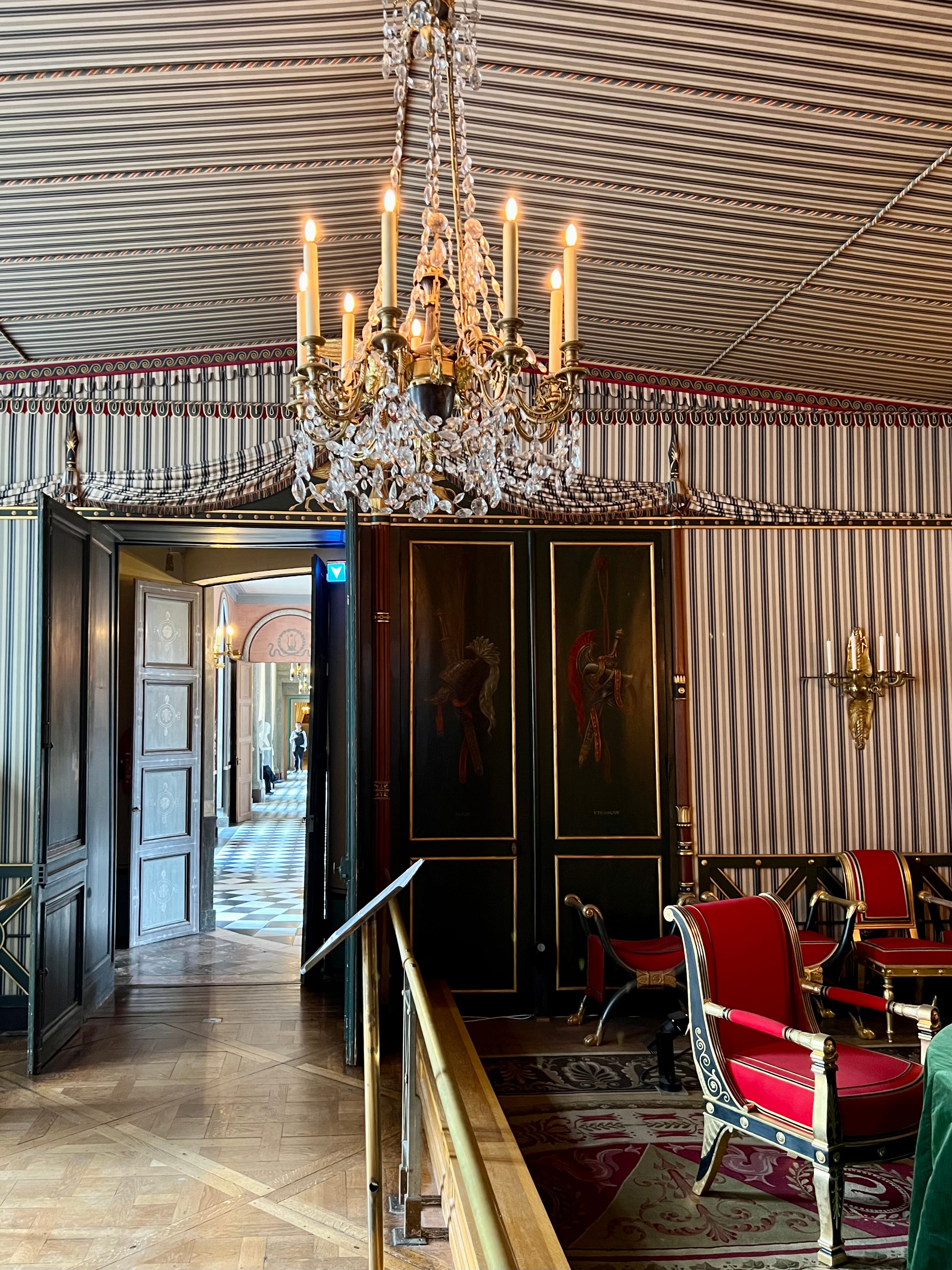
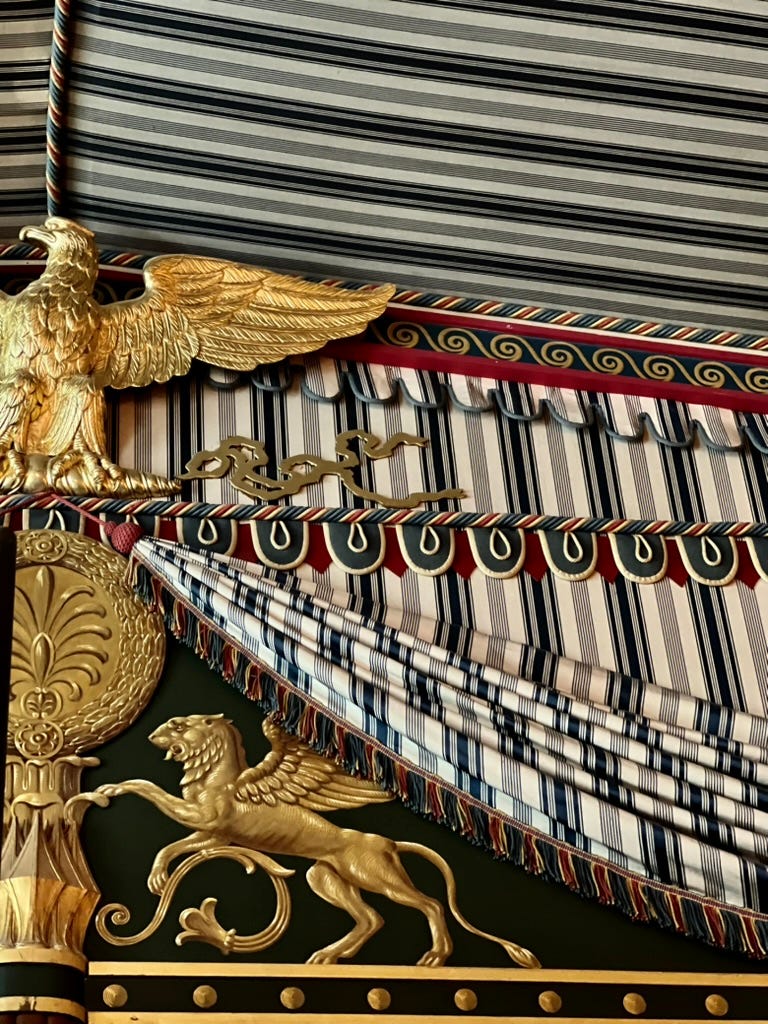
A closer look at the eagle, lion and tenting details.
Dining Room
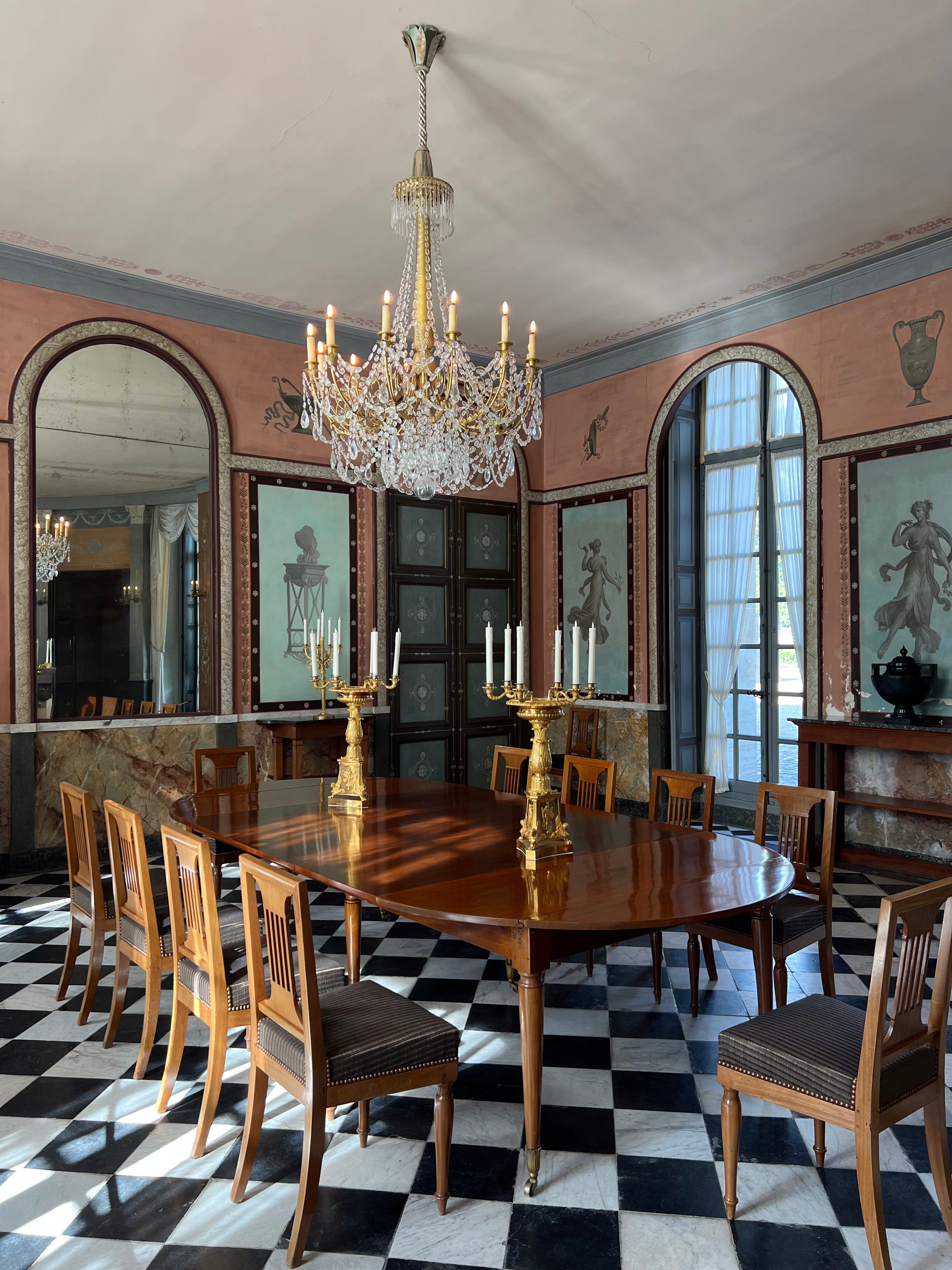
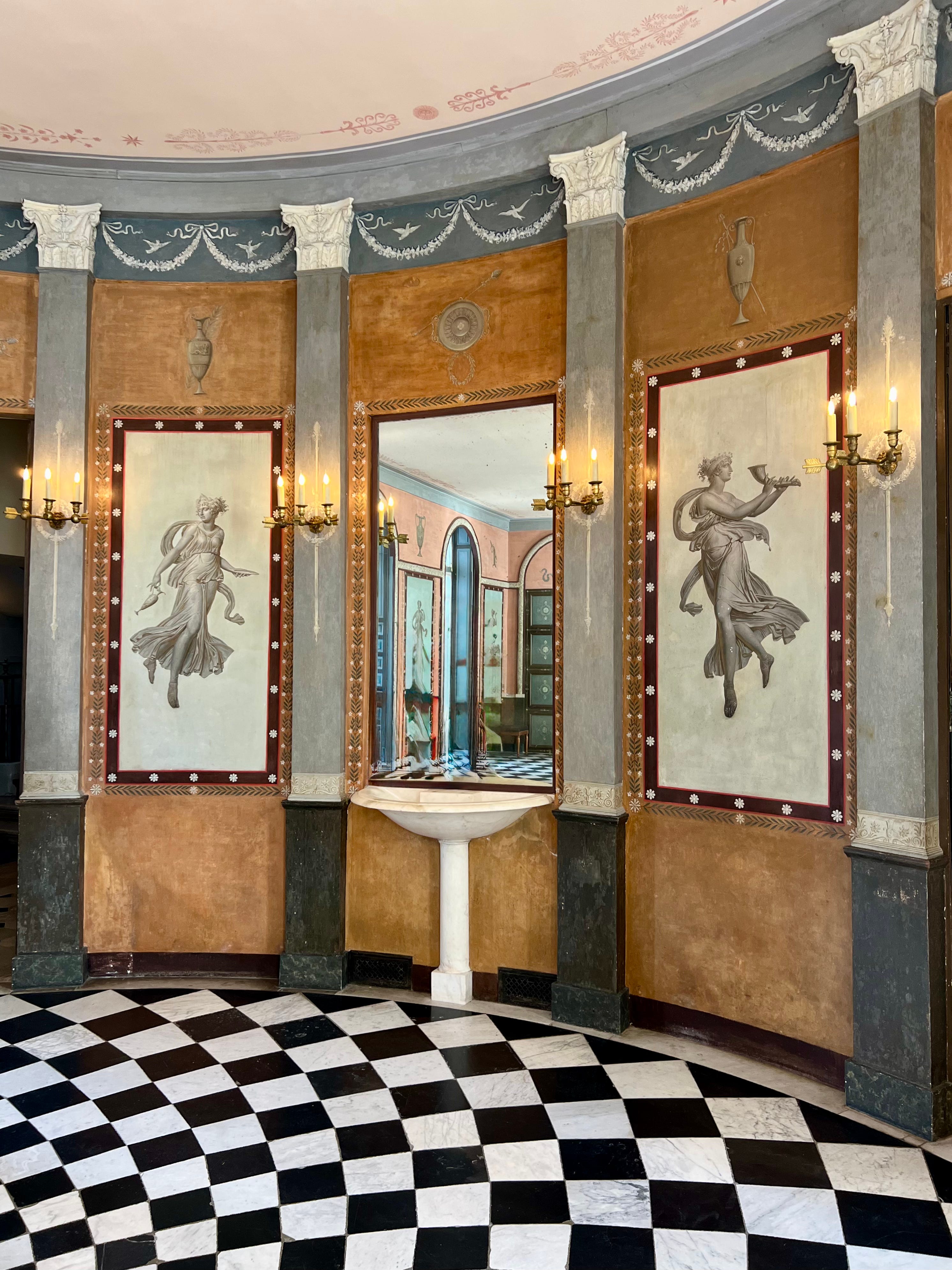
The dining room, below, has Pompeian decoration hand painted on the walls and a beautiful marble floor in a circular pattern at one end.
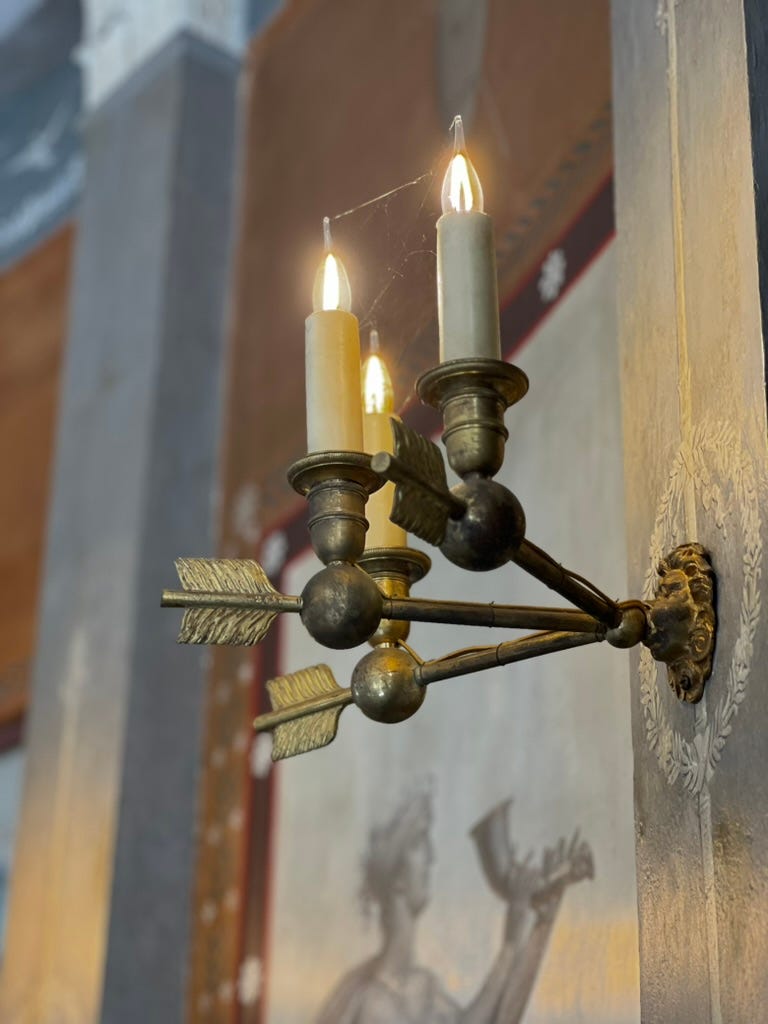
A sconce in the dining room, below.
Billards Room
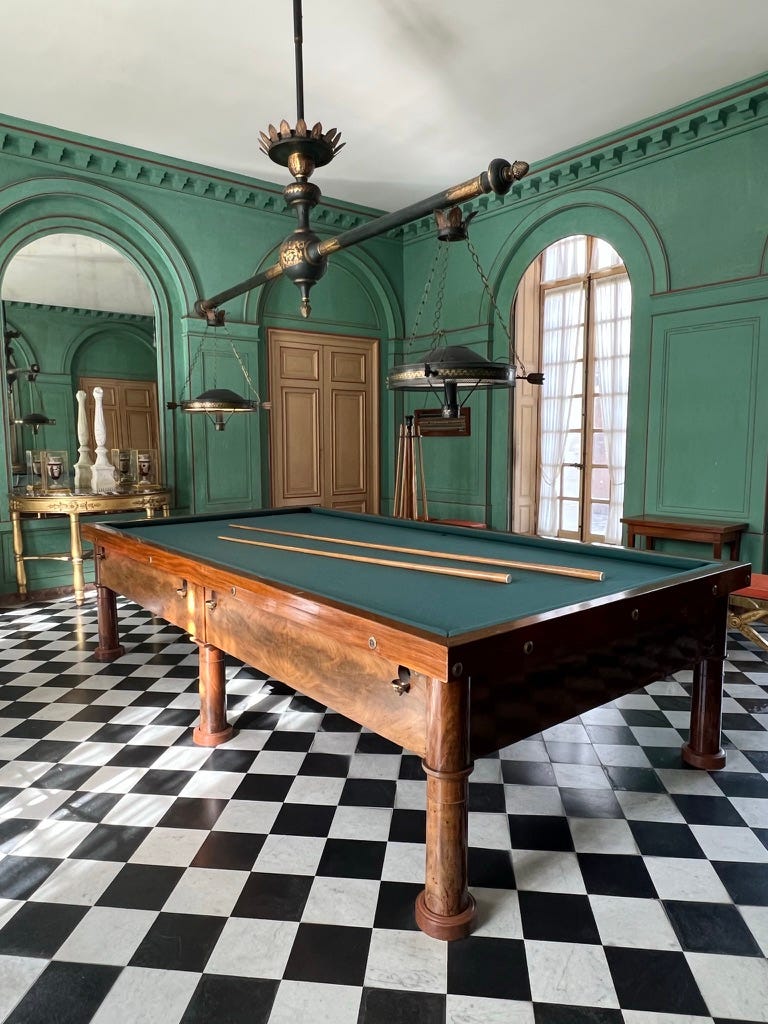
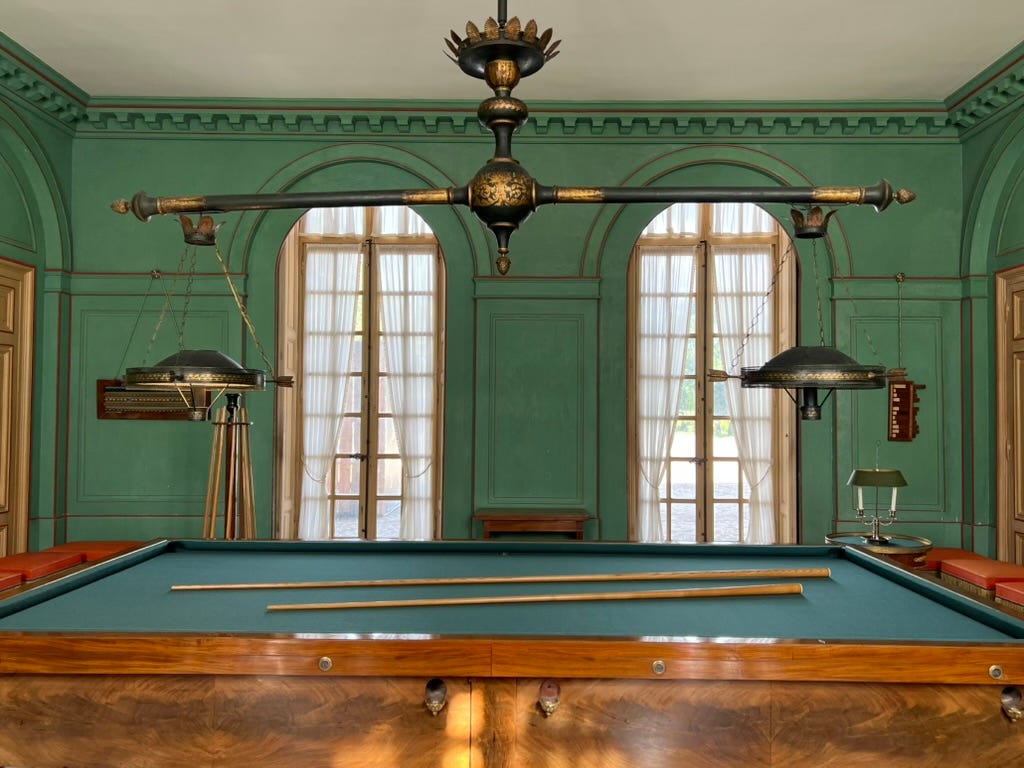
The Billards Room has been used as such since 1703, and was repainted in the colors shown below by Louis-Martin Berthault in 1812. The pendant appears to be lacquered or painted and has tole shades.
Library
Music Room
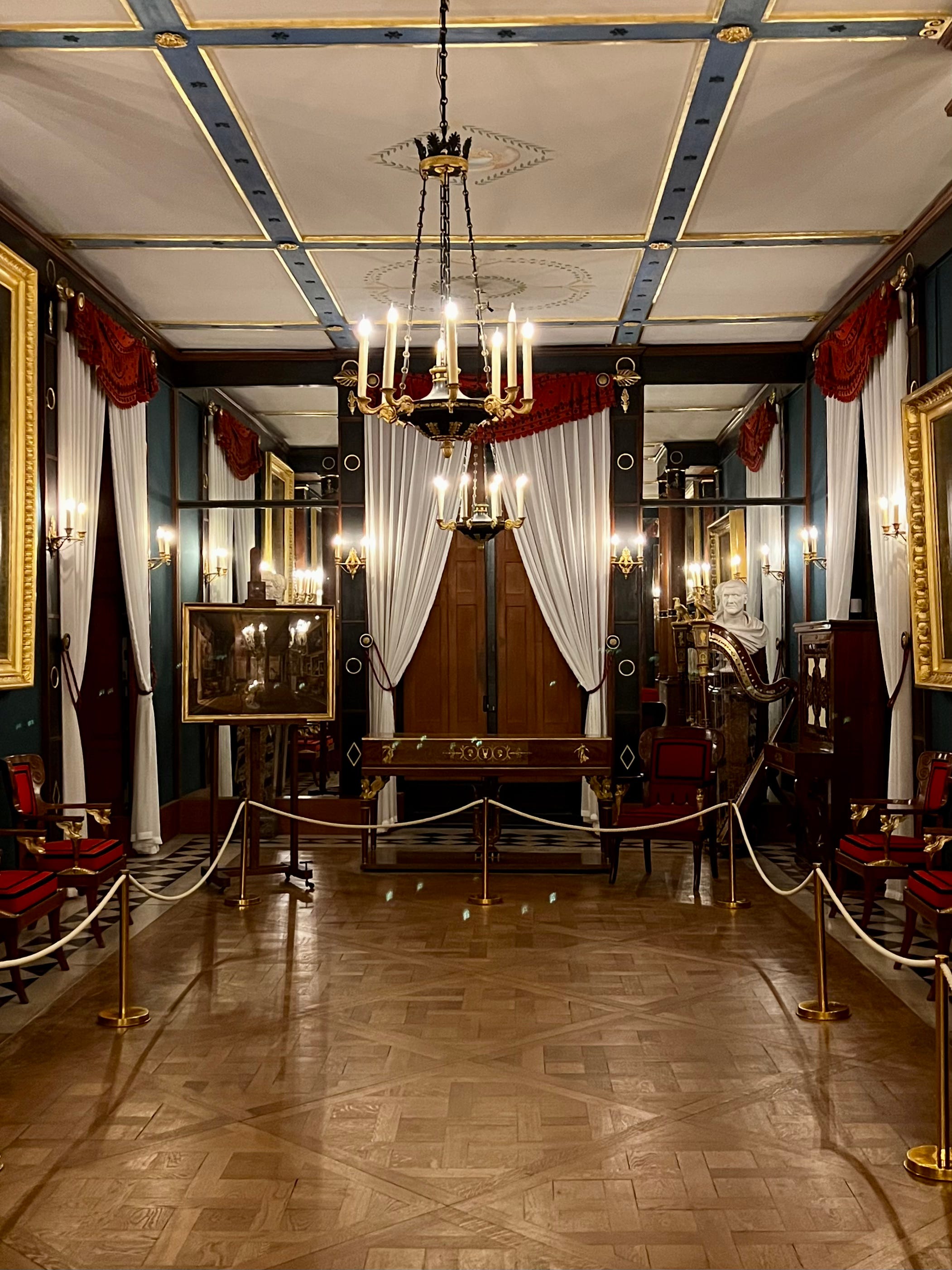
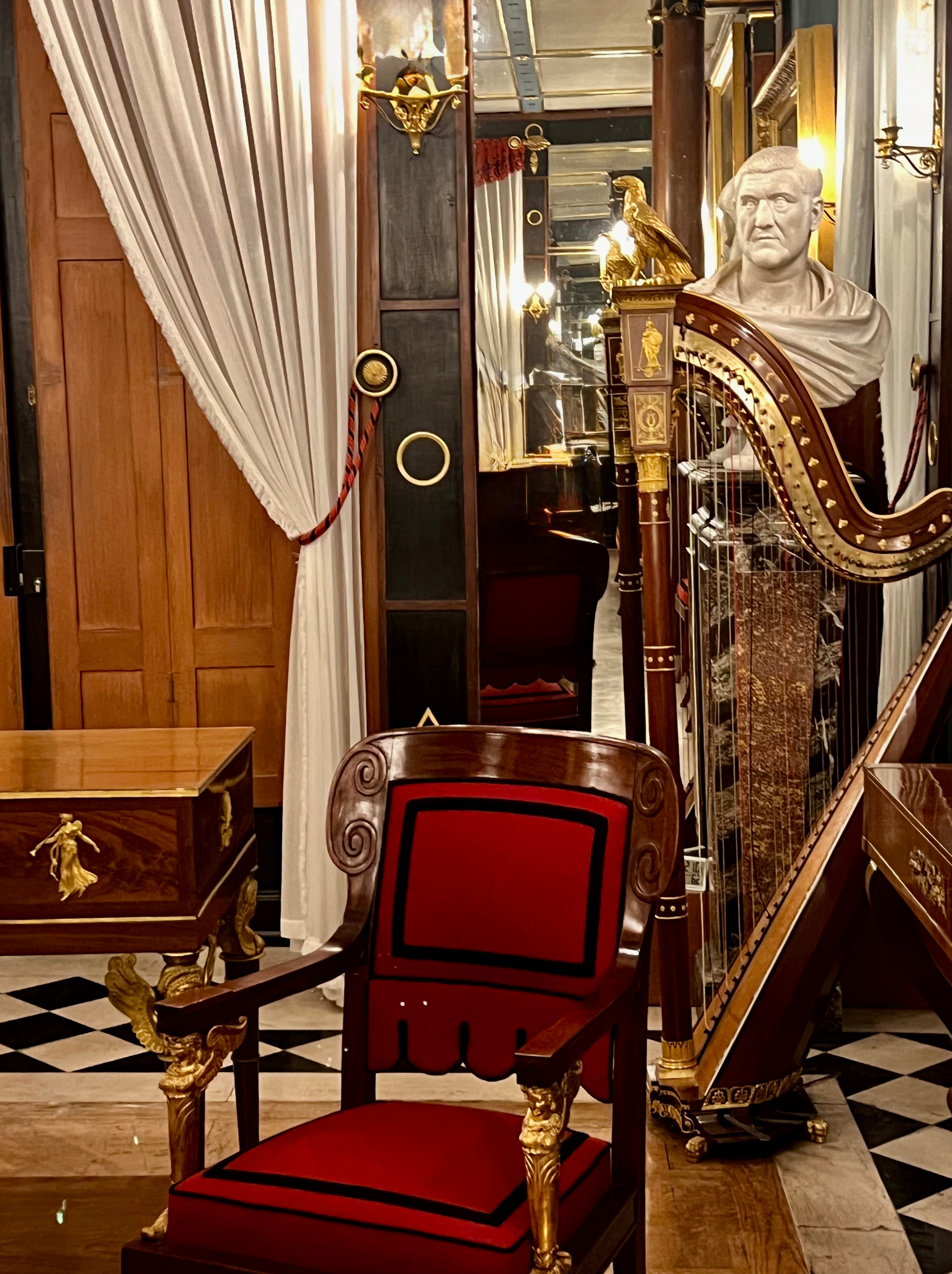
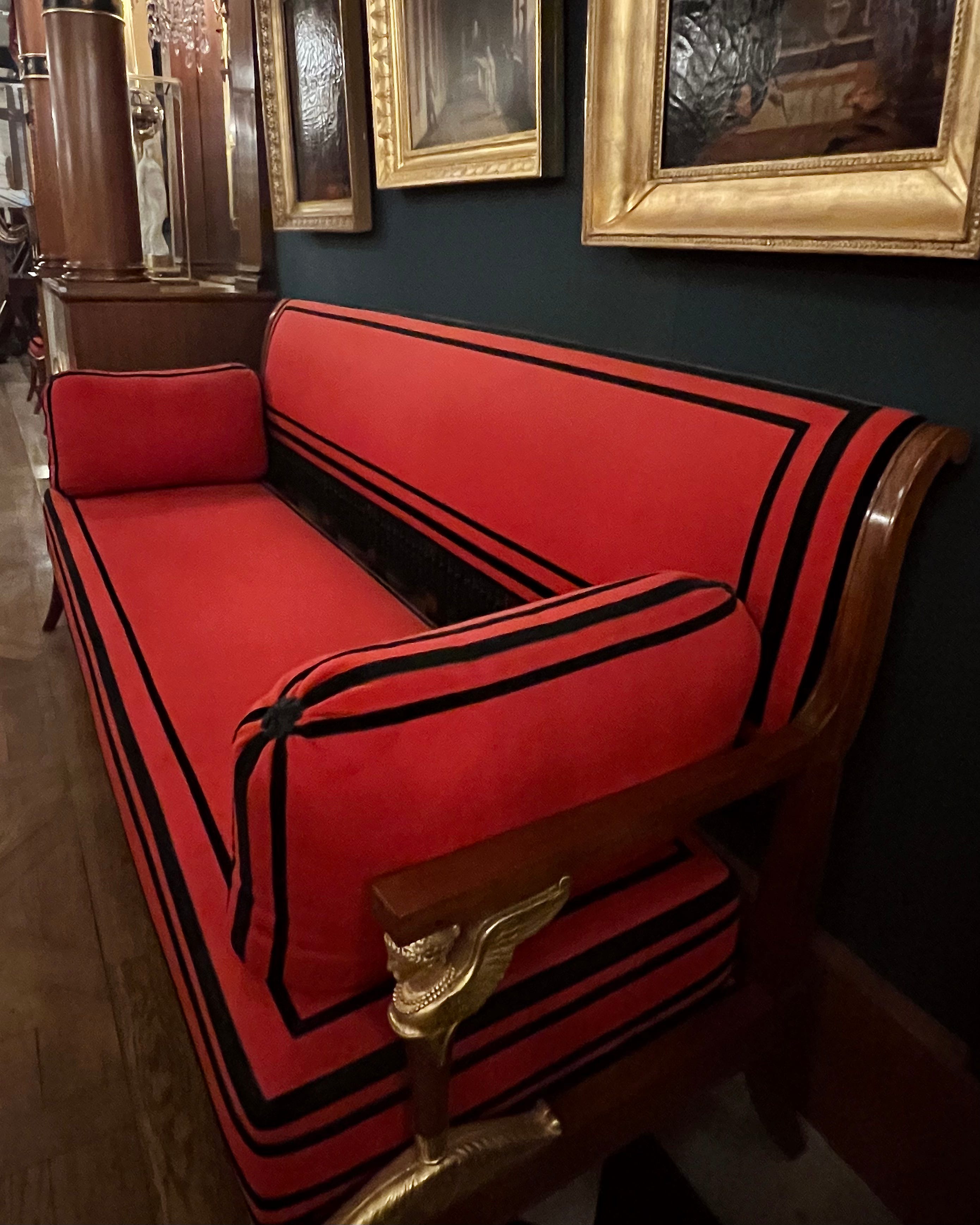
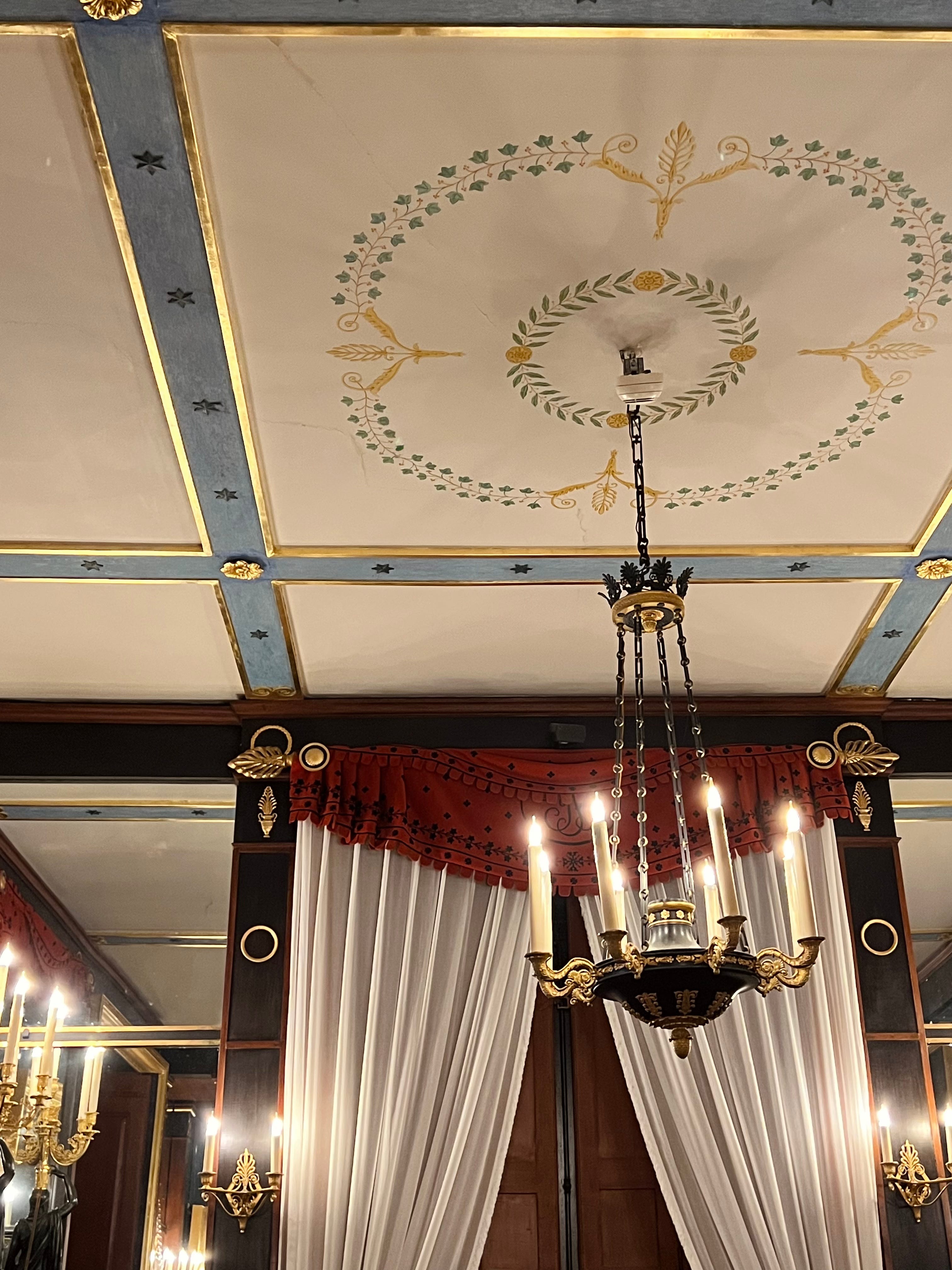
Josephine’s harp in the Music Room, followed by a close look at the upholstery, lighting and ceiling details in the space. (Sorry for the glare, how I would have loved to turn down the lights.)
Front Vestibule and Staircase
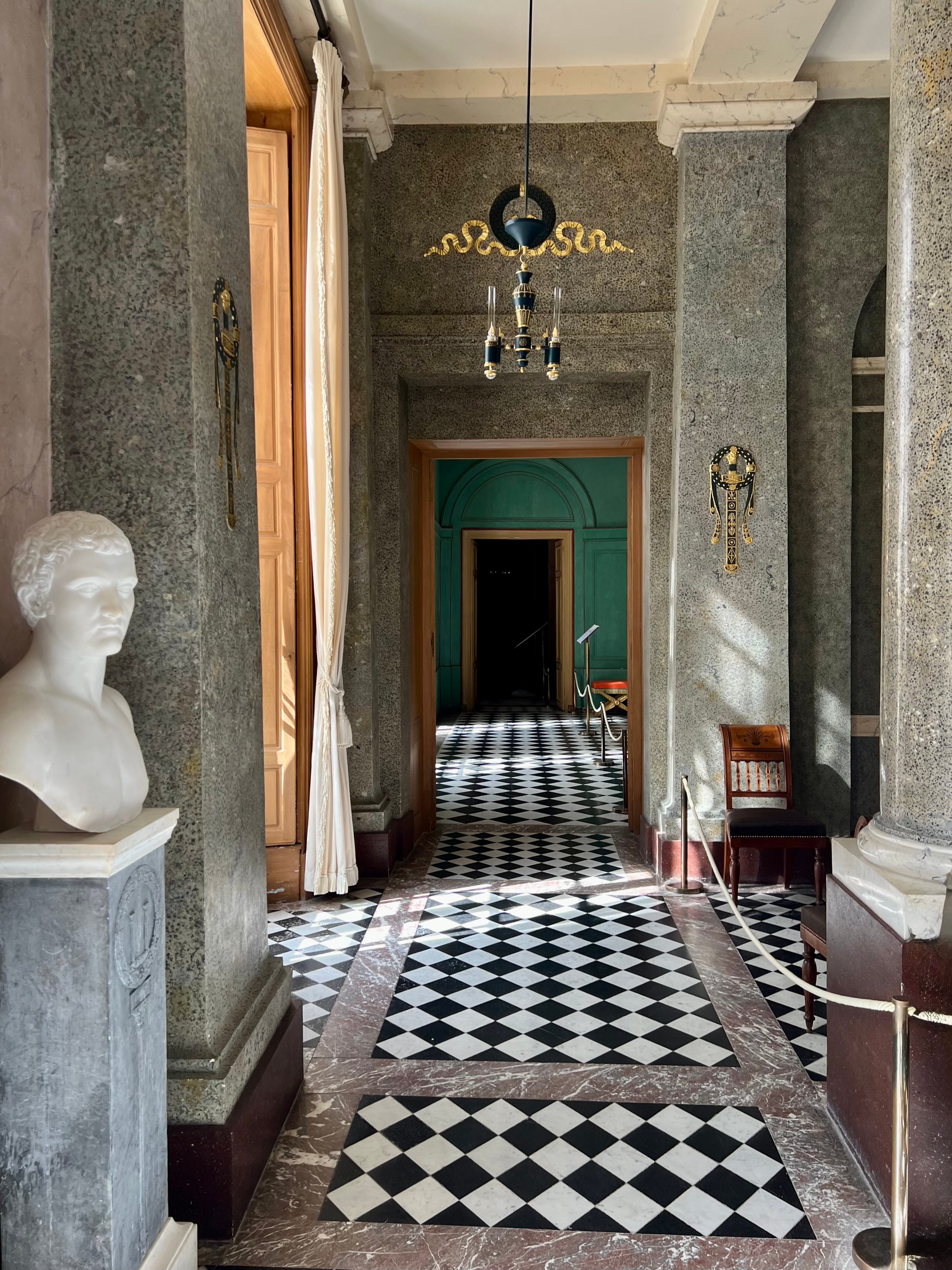
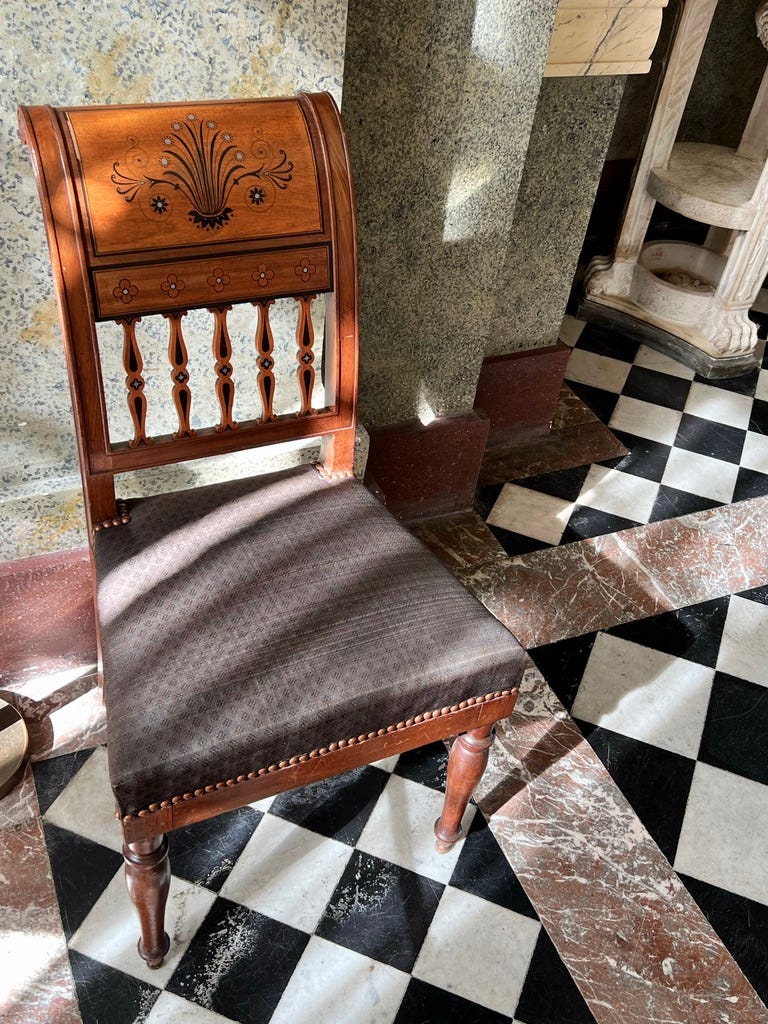
The front vestibule, below, was designed to evoke a Roman atrium and has a black, white and porphyry marble floor that is used throughout the first floor of Malmaison. A wooden staircase follows.
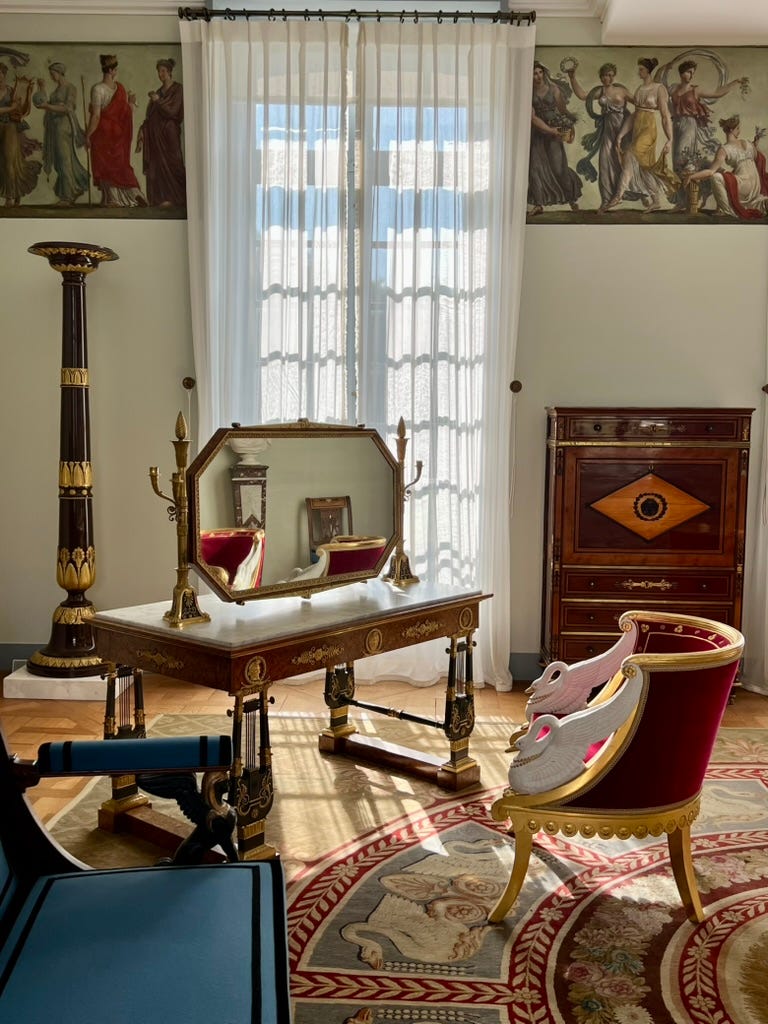
Frieze Room
A pretty ancillary room on the second floor showcases a classical frieze and a swan chair designed by Charles Percier surrounded by furniture in the Empire style. Note the swans in the rug.
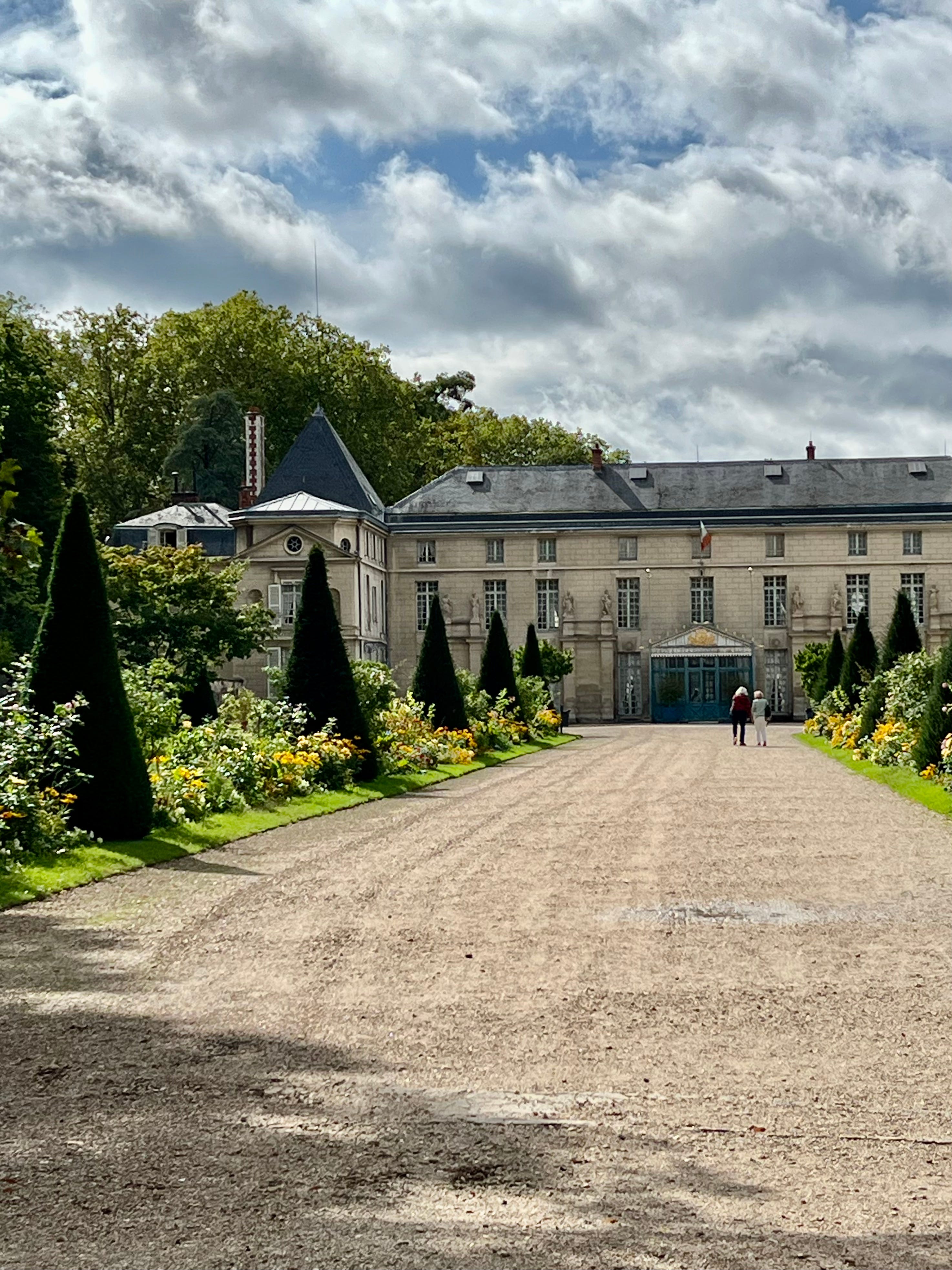
Exterior
The exterior in late September.
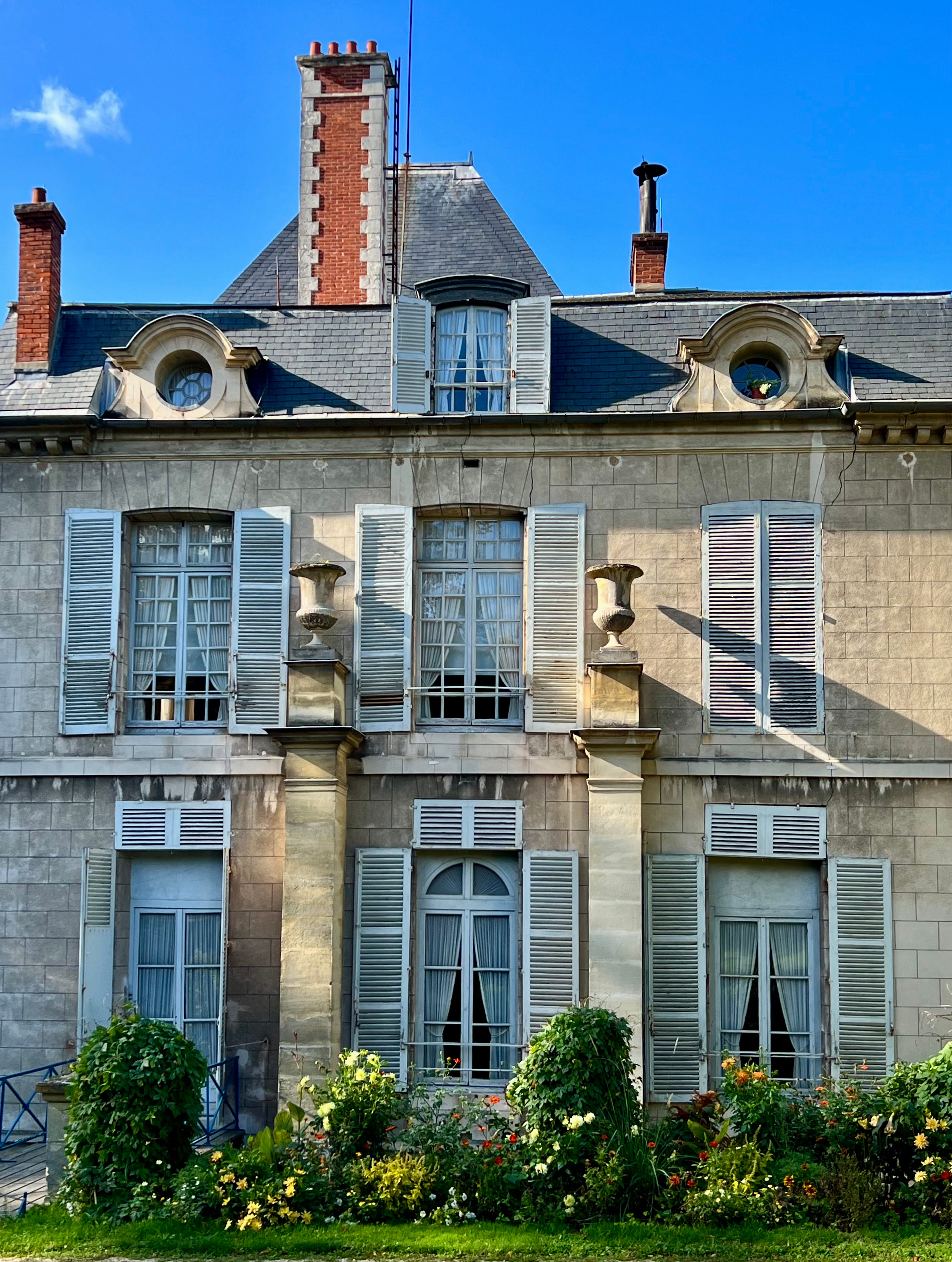
Percier and Fontaine designed the columns topped with urns and statuary to hide buttresses supporting the building.
Contemporary Designs
Here are few rooms by contemporary designers that bring to mind Malmaison. Sources and designers noted.
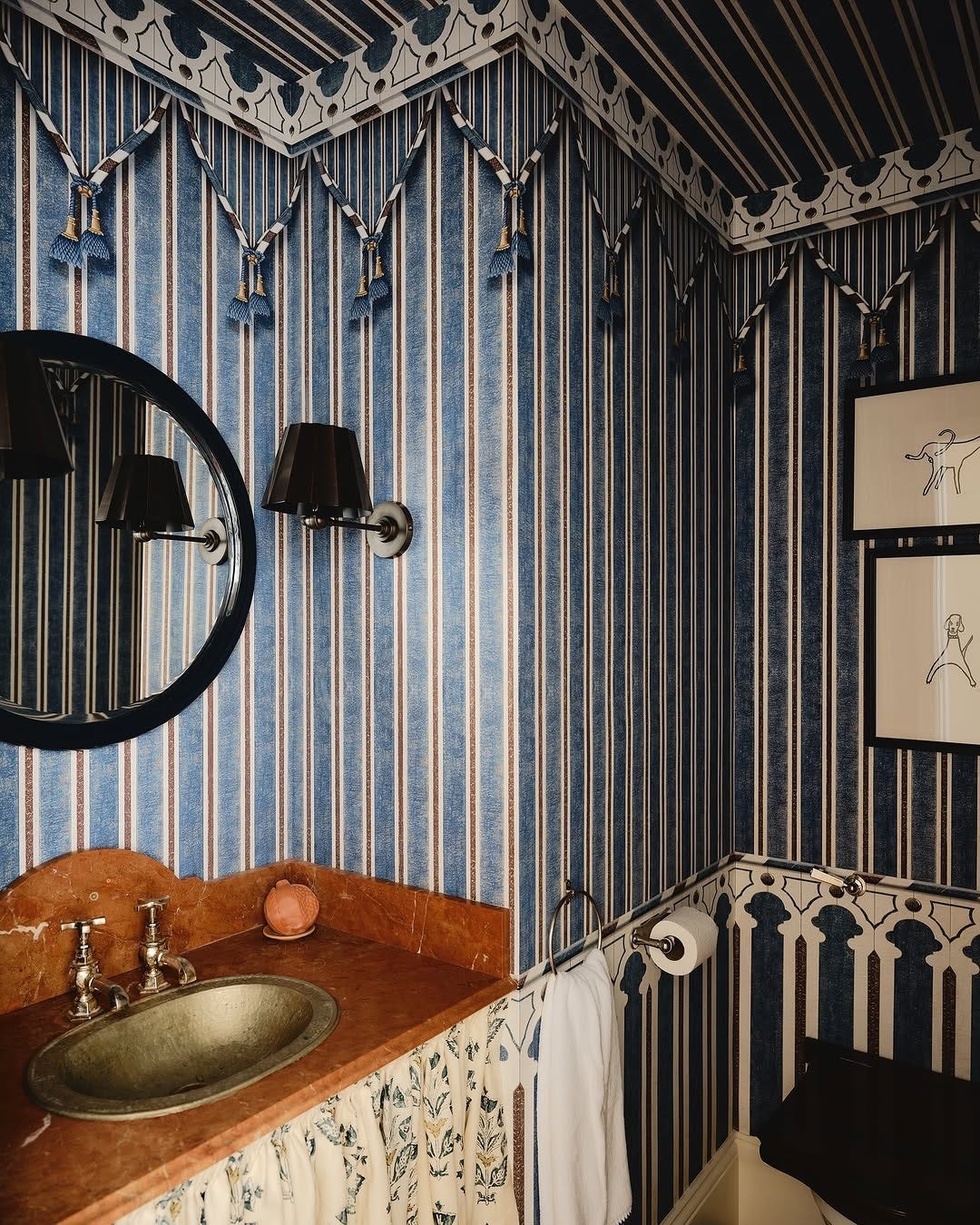
Below, a tented powder room designed by Rosanna Bossom Ltd, photo by Dean Hearne. Instagram.
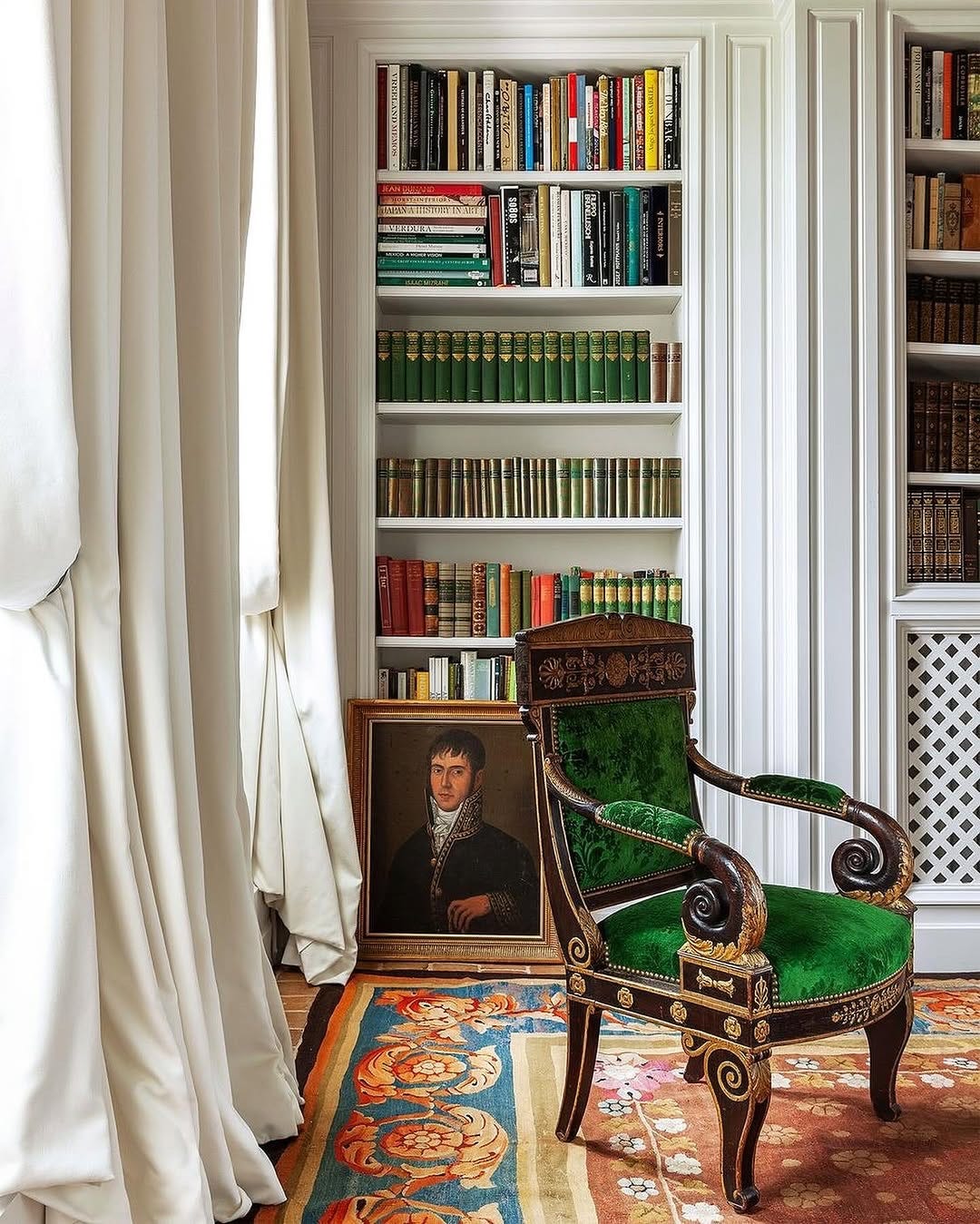
Robert Couturier’s home in Normandy exudes the same type of quiet luxury found at Malmaison, featured in Elle Decor, photo by Sylvie Becquet. Instagram. Simple white drapery sets off an Aubusson rug from the 1820s and a chair said to be Napoleon’s from Malmaison.
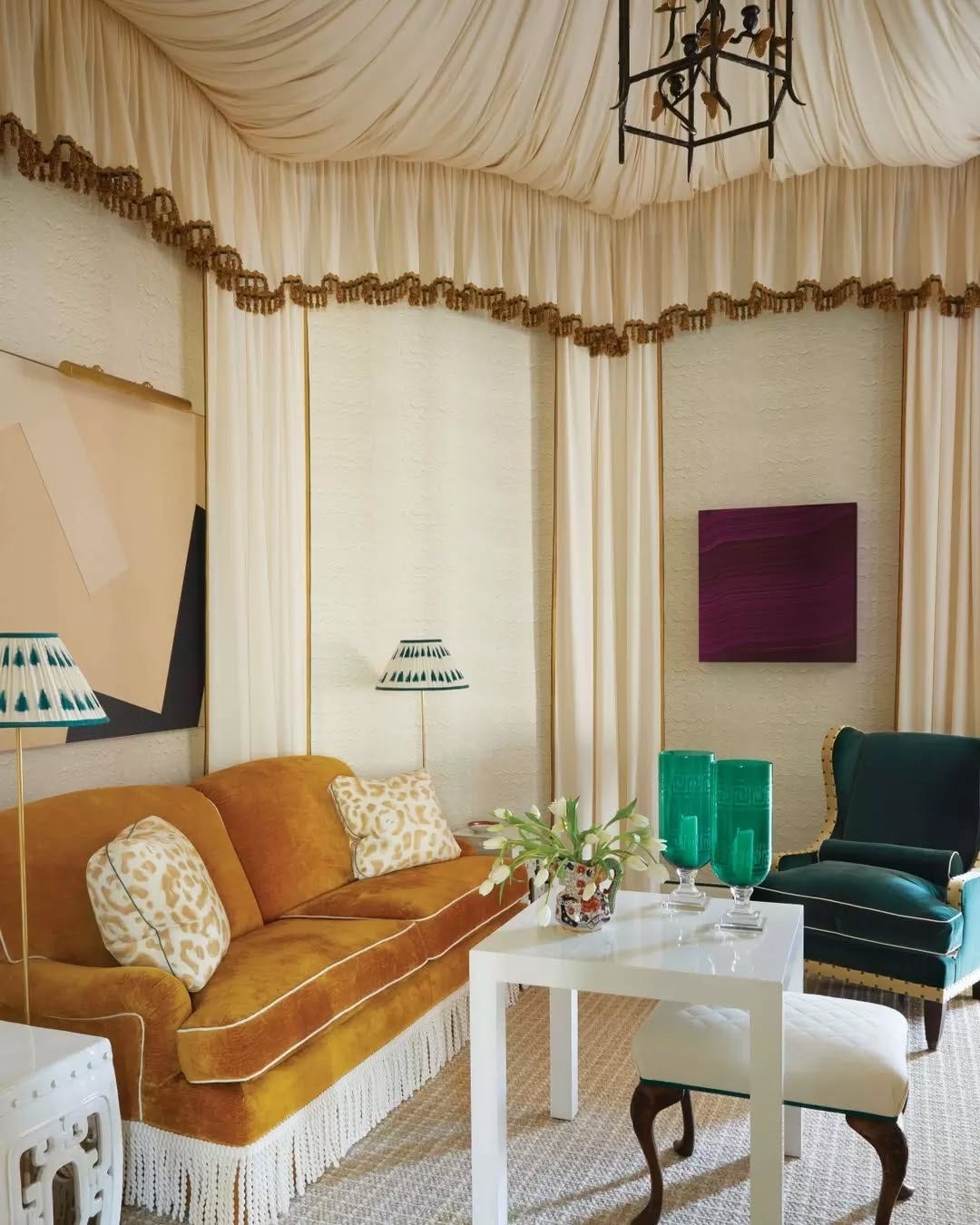
An octoganal vestibule by Christopher Alexander, photographed by Melanie Acevedo featured in Frederic. Instagram.
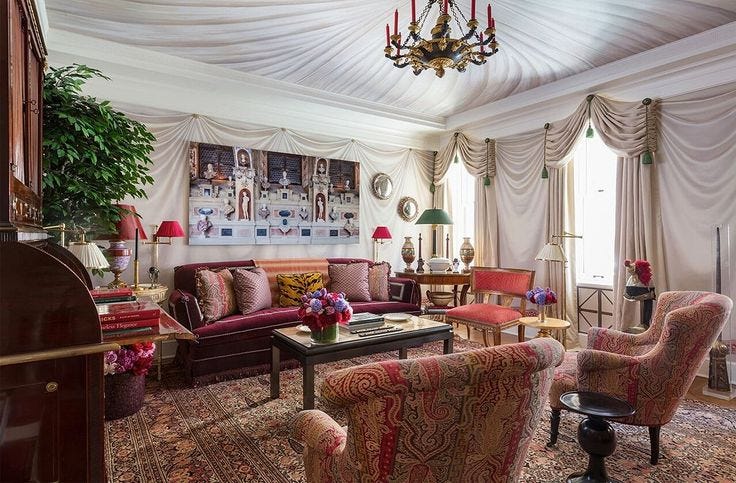
In her room for the 2018 Kips Bay Show House, below, Alexa Hampton created a trompe l’oeil, tenting effect on the walls and ceiling with paint. One King’s Lane.
Look forward to the garden episode
Great post, Lynne! We just returned from Paris this week and I’m regretting not squeezing in a visit to Malmaison. Next time!